
Why the Right Drywall Mirror Anchor Kit Can Save Your Mirror — and Your Wall
A drywall mirror anchor kit is the safest, most reliable way to hang a heavy mirror on a wall without a stud. Here’s a quick summary of what you need to know:
Best drywall mirror anchor kits at a glance:
| Anchor Type | Best For | Max Weight |
|---|---|---|
| French Cleat (e.g., OOK) | Large, heavy mirrors | 200-300 lbs |
| 3M CLAW | No-tool, quick installs | Up to 65 lbs |
| Twist-N-Lock (E-Z Ancor) | Mid-weight items | Up to 50 lbs |
| Bullfix Universal Kit | Complete DIY kit | Up to 66 lbs |
| Hillman AnchorWire Kit | Framed mirrors | Up to 100 lbs |
Hanging a large mirror feels exciting — until you realize your wall is hollow drywall with no stud where you need it.
Most drywall is only 1/2 to 5/8 inch thick. That’s not much material to grip. Without the right anchor, a heavy mirror can pull free from the wall entirely.
The good news: modern drywall mirror anchor kits are engineered specifically for this problem. Some support up to 300 lbs. Others install in seconds with no tools at all.
Whether you’re mounting a smart mirror, a decorative statement piece, or a full-length closet mirror, choosing the wrong anchor is the single biggest mistake DIYers make — and it’s completely avoidable.
This guide covers the top-rated kits, how they work, and exactly how to install them safely.
Understanding the Drywall Mirror Anchor Kit
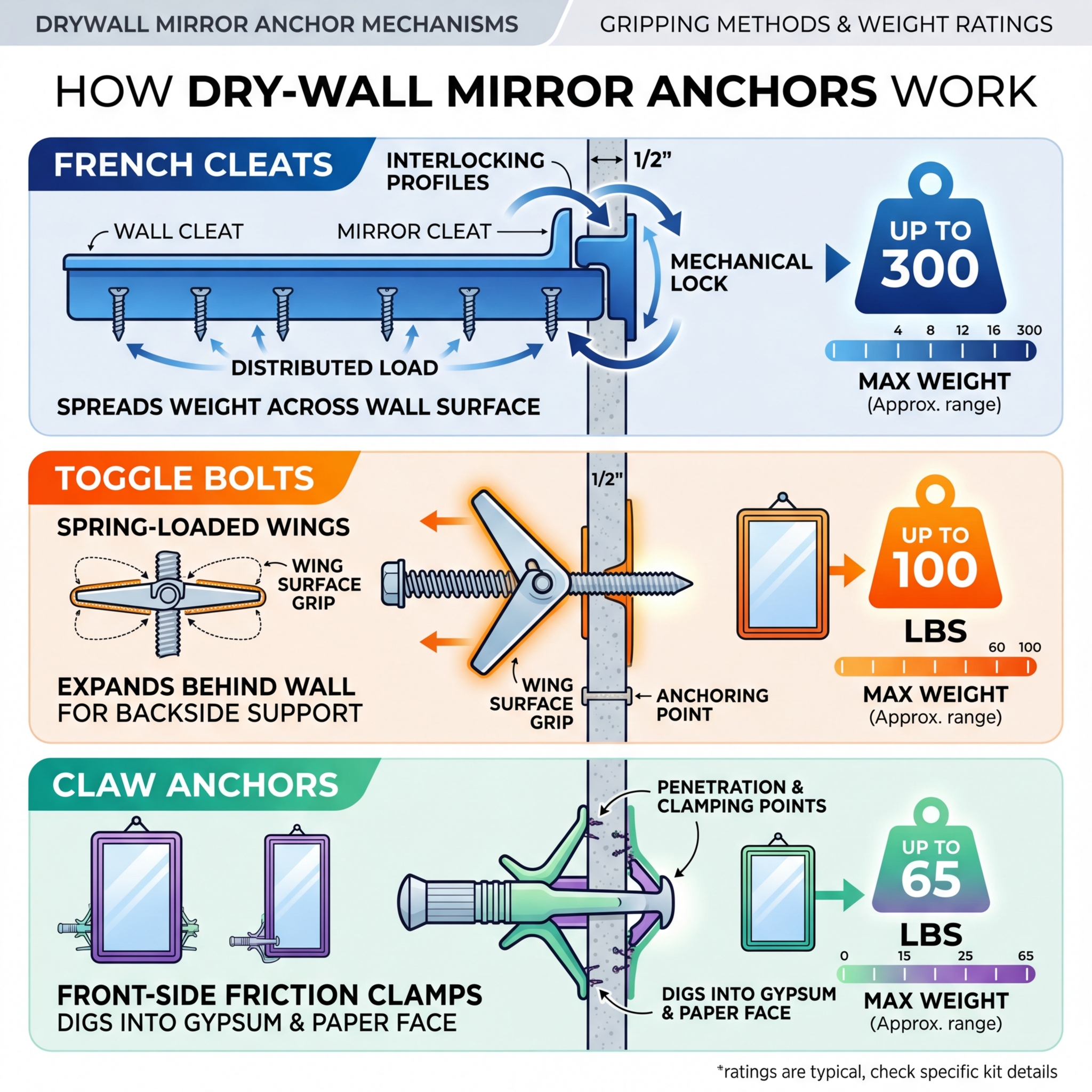
When we talk about a drywall mirror anchor kit, we are referring to a specialized set of hardware designed to distribute the weight of a heavy object across a wider surface area of the wall. Unlike a standard nail, which relies on the friction of a thin piece of gypsum, these kits use mechanical advantages to stay put.
To choose the right kit, we need to understand two forces: Shear and Tension.
- Shear force is the downward pull (gravity) trying to slide the anchor down the wall.
- Tension is the outward pull trying to yank the anchor straight out of the hole.
Heavy mirrors create significant shear force. Most kits are rated based on this downward pressure. However, if a mirror leans forward, it adds tension. This is why “hollow wall mechanics” are so important; the anchor must grip the back of the drywall, not just the inside of the hole.
How a Drywall Mirror Anchor Kit Works
The magic of these kits lies in how they interact with the hollow space behind your wall.
- Expansion: Traditional plastic anchors expand inside the wall as a screw is driven in, wedging themselves against the sides of the hole.
- Threading: Self-drilling or “Twist-N-Lock” anchors have deep, wide threads that bite into the drywall like a corkscrew, creating a much larger surface area of contact.
- Toggle Mechanism: These are the heavy hitters. A metal bar or “wing” is pushed through a hole and then flips open on the back side of the drywall. When you tighten the screw, the wing is pulled tight against the back of the wall, making it nearly impossible to pull out.
- Grip Strength: Products like the 3M CLAW use hardened steel claws that lock into the gypsum core of the drywall, using the material’s own density to provide support without needing a large hole or a toggle.
Choosing the Right Drywall Mirror Anchor Kit for Your Project
Before we go shopping, we must weigh the mirror. Don’t guess—use a bathroom scale. A mirror that feels “about 20 pounds” often turns out to be 45 pounds once the frame is included.
Next, consider your wall thickness. Most residential drywall is 1/2 inch, but older homes or fire-rated walls might be 5/8 inch. Some kits, like the Bullfix Mirror/Picture Hanging Kit, are specifically designed to work on standard 1/2″ to 5/8″ boards with as little as a 1/4″ cavity behind them.
If you are a renter or just hate using a drill, look for tool-free options. The 3M CLAW™ Drywall Picture Hanger 25 lb 3PH25-1EF, 1 hanger is a fantastic choice for mid-weight mirrors. It pushes in with your thumbs and leaves only tiny slits rather than gaping holes.
Top Types of Heavy-Duty Mirror Anchors
There is no “one size fits all” when it comes to mirrors. A sleek, frameless bathroom mirror requires different hardware than a 100-pound ornate floor mirror. For those looking into high-tech upgrades, we recommend checking out choosing the right mounting hardware for your smart mirror for specialized advice.
High-Capacity French Cleat Systems
For the heaviest projects, French cleats are the gold standard. These consist of two interlocking aluminum brackets. One is leveled and screwed into the wall; the other is attached to the back of the mirror.
- Weight Capacity: Systems like the OOK 30-inch French Cleat can support up to 300 lbs.
- Accuracy: Because the bracket is long, it’s much easier to get the mirror perfectly level.
- Safety: Once the mirror “drops” into the wall bracket, it cannot slide left or right or be easily knocked off the wall.
Self-Drilling and Twist-N-Lock Options
If your mirror is in the 30-to-50-pound range, a drywall mirror anchor kit featuring Twist-N-Lock technology is often the most convenient.
- No Pre-drilling: These anchors have a sharp point that creates its own hole as you screw it in.
- Materials: Nylon versions are common, but zinc anchors offer higher durability for heavier loads.
- Capacity: The popular E-Z Ancor Twist-N-Lock is rated for 50 lbs in 1/2-inch drywall.
| Anchor Type | Weight Capacity | Installation Effort | Tool Required |
|---|---|---|---|
| French Cleat | 100 – 300 lbs | High | Drill, Level |
| Toggle Bolt | 50 – 100 lbs | Medium | Drill |
| Self-Drilling | 25 – 75 lbs | Low | Screwdriver |
| Steel Claws (3M) | 15 – 65 lbs | Very Low | None (Thumb) |
| Wall Dogs | 50 lbs | Low | Screwdriver |
Step-by-Step: How to Install a Drywall Mirror Anchor Kit
Ready to start? Let’s walk through the process. Whether you are installing a standard mirror or building and installing a wall-mounted smart mirror, the preparation steps remain the same.
Preparation and Wall Marking
- Find the Studs: Even if you plan to use anchors, we always recommend checking for studs first. If you can hit even one stud with a screw, your installation becomes exponentially stronger.
- Measure Twice: Measure the distance from the top of the mirror to the hanging hardware (the D-rings or wire).
- Mark the Height: Use painter’s tape on the wall to mark where the top of the mirror will sit. Then, measure down to mark the exact spot for your anchors.
- Level Everything: Use a spirit level to ensure your marks are perfectly horizontal. A mirror that is 1/8th of an inch off at the anchor point will look drastically crooked once hung.
Securing the Hardware
Once your marks are set, it’s time to install the drywall mirror anchor kit.
- For Self-Drilling Anchors: Place the tip of the anchor on your mark and use a screwdriver to turn it clockwise until the head is flush with the wall. Do not over-tighten, or you might strip the drywall.
- For Toggle Bolts: You will need to drill a pilot hole (usually 1/2 inch). Squeeze the metal wings of the toggle, push it through the hole until you hear them “click” open on the other side, and then tighten the screw.
- For Bullfix Kits: This kit is unique because it uses a patented wing design. Use the included spade bit to drill a hole, insert the fixing, and the design ensures the wings are fully open before you can even begin to screw in the hook.
- For French Cleats: Screw the wall bracket into your marks. If the bracket is long enough to span 16 inches, try to get at least one screw into a wall stud for maximum security.
Common Mistakes and Safety Tips for Heavy Mirrors
We’ve seen many “DIY disasters” that could have been avoided with a little extra caution. When dealing with glass that weighs as much as a small child, safety is the priority.
Avoiding Wall Damage
One common mistake is using the wrong anchor for the wall type. For instance, a drywall mirror anchor kit designed for 1/2-inch sheetrock may fail if used on old-fashioned lath and plaster. Plaster is brittle; using a self-drilling anchor can cause the wall to crack or crumble. For plaster, always pre-drill a pilot hole.
Another tip: if you ever need to remove an anchor, don’t just pull it out. For Twist-N-Lock anchors, simply unscrew them. For toggle bolts, we recommend unscrewing the bolt and pushing the metal toggle into the wall cavity where it will fall harmlessly to the bottom. You can then patch the small hole with a bit of spackle.
Ensuring Long-Term Stability
- Multiple Anchors: If a mirror is particularly wide, don’t rely on a single center anchor. Using two anchors spaced apart distributes the weight and prevents the mirror from tilting.
- Anti-Tip Kits: For leaning floor mirrors, always use an anti-tip kit. This usually involves a small cable anchored to the wall to prevent the mirror from sliding forward if bumped.
- Vibration and Moisture: In bathrooms, steam can weaken drywall over decades. Ensure your anchors are corrosion-resistant (like zinc or plastic) and check them every few years to ensure they remain tight.
Frequently Asked Questions about Mirror Anchors
Can I hang a 100lb mirror on drywall without a stud?
Yes, but you must use the right hardware. A standard plastic plug anchor will fail. Instead, use a heavy-duty French cleat system or multiple high-capacity toggle bolts. For example, the OOK 200 lbs. French Cleat Picture Hanger is specifically designed for these high-stress scenarios and uses “Wall Dog” mounting screws that provide incredible grip even without a stud.
What is the best anchor for a frameless mirror?
Frameless mirrors don’t have a wooden frame to screw into. For these, we recommend a “Mirror Holder Kit” like the one from Hillman. These kits usually include J-molds or clips that cradle the glass and are secured to the wall using hollow wall anchors. Always ensure the clips are rated for the thickness of your glass.
How do I remove heavy-duty anchors without leaving large holes?
The “no-hole” dream is best achieved with the 3M CLAW. If you’ve used a toggle bolt, you’re stuck with a roughly 1/2-inch hole. To repair this, we suggest:
- Pushing the hardware into the wall.
- Using a utility knife to slightly bevel the edges of the hole inward.
- Applying a mesh patch or just filling with high-quality spackle.
- Sanding and painting once dry.
For more detailed guides on advanced setups, you can read choosing the right mounting hardware for your smart mirror to see how different wall types affect your choices.
Conclusion
At Foco Finanças, we believe that home improvement should be empowering, not stressful. Taking the time to select the correct drywall mirror anchor kit ensures that your beautiful decor stays on the wall where it belongs.
Whether you are using a simple 3M CLAW for a 15-pound frame or a professional-grade French cleat for a 300-pound masterpiece, the key is matching the hardware to the weight and following the installation steps precisely. Always perform a final “tug test” (gently!) to ensure the mount is secure before walking away.
For those looking to take their home decor to the next level with technology, be sure to explore our resources on smart mirror installation for more expert tips and DIY inspiration. Happy hanging!
