
Understanding Fiber Optic Mirror Lighting Technology
Fiber optic mirror lighting is one of the smartest ways to add clean, glowing light to a mirror — with zero heat, no electricity at the light point, and a lifespan that blows traditional bulbs out of the water.
Quick answer — what you need for fiber optic mirror lighting:
- An LED illuminator — the light source (kept away from the mirror)
- PMMA fiber optic cables — carry light from the illuminator to the mirror
- Mirror end fittings (like UFO 19M or UFO 26M) — deliver light at a 90° angle in tight spaces
- A controller — DMX, RF remote, or manual dimmer for color and brightness
These four components work together to pipe light exactly where you need it, without any wiring running to the mirror surface itself.
That separation of light source from light point is what makes fiber optic systems so different. The illuminator sits safely out of sight, and thin PMMA fibers carry the light forward. No heat. No electrical current at the mirror. Just a clean, even glow.
This matters a lot if you’re planning a smart mirror build. Complex wiring behind a mirror is a real headache — and a safety concern. Fiber optics sidestep that problem entirely.
The technology is used everywhere from sensory therapy rooms to luxury hotel bathrooms to retail displays. And with modern LED illuminators now lasting over 40,000 hours, the maintenance burden is almost nothing.
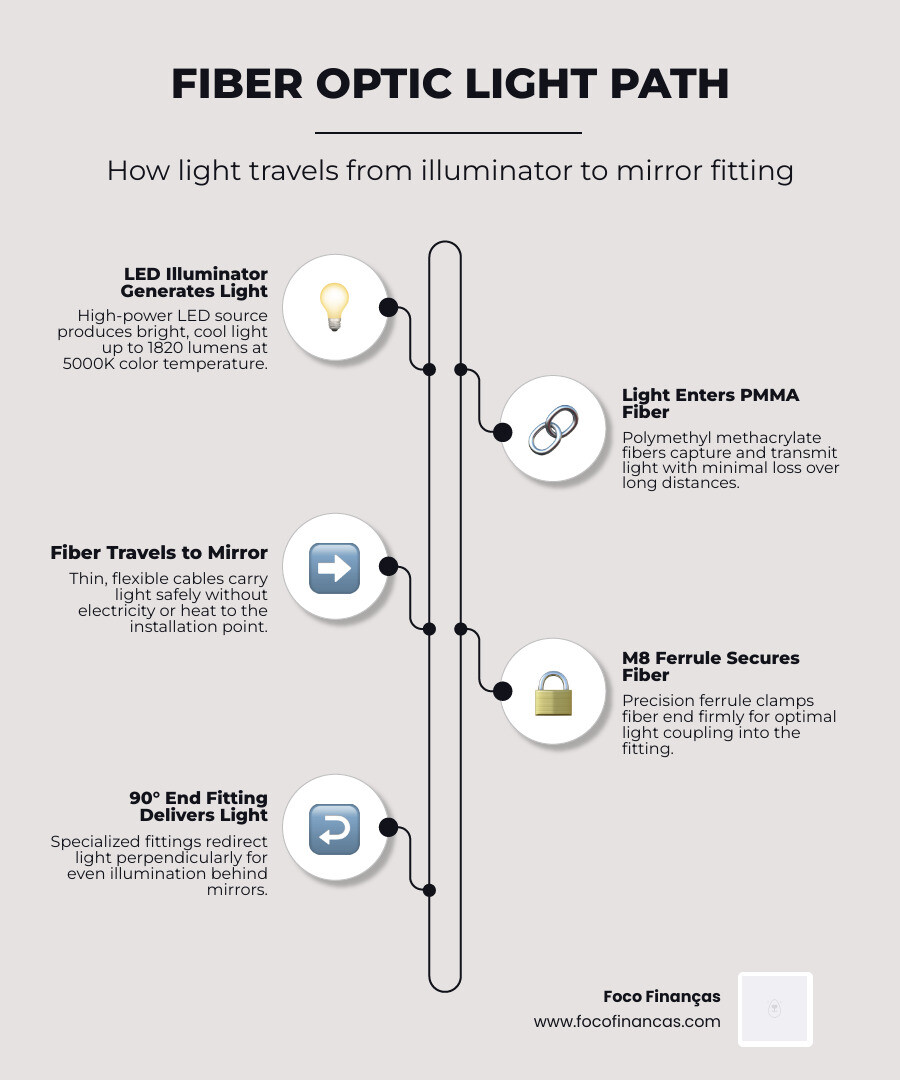
To truly master this setup, we need to look at how light travels through these systems. Unlike a standard LED strip that shines forward, fiber optic mirror lighting often relies on specialized “end fittings.” These fittings use M8 ferrules to secure the fiber and are designed to deliver light at a precise 90-degree angle to the run of the fiber tail. This is a game-changer for mirrors because it allows the light to exit perpendicular to the glass even when the cable is running parallel behind it.
When selecting your essential materials for your smart mirror, understanding this 90-degree delivery is vital. It means you don’t need a massive cavity behind your mirror to loop cables; the fittings do the directional work for you.
High-Performance Illuminators for Fiber Optic Mirror Lighting
The heart of any fiber optic mirror lighting system is the illuminator (or light engine). This is where the magic happens. Gone are the days of noisy, hot 150W halogen lamps that burned out after 200 hours. Modern LED technology has completely revolutionized this space.
For instance, high-power units like the Fiber-Lite Mi-LED Illuminator – High Power, Long Life Fiber LED Illuminator | Dolan-Jenner offer a staggering lifespan of over 40,000 hours. To put that in perspective, if you left your mirror light on for 8 hours every single day, it would last nearly 14 years. These units typically provide a crisp 5000K color temperature, which is ideal for grooming or detailed inspection tasks.
If you are looking for something more compact for a residential project, the Mira – BL Lighting is a fantastic choice. It is an efficient 18W LED illuminator that punches well above its weight, emitting 1820 lumens. Its miniature size (roughly 8.75” x 4.5”) allows it to hide in small cabinets or narrow ceiling voids.
When you begin up-your-smart-mirror-game-with-smart-lights-integration, the illuminator is the one component you shouldn’t skimp on. A high-quality light source ensures that the “glow” at the mirror edge is uniform and flicker-free.
Specialized Fittings and Fiber Optic Mirror Lighting Kits
Once you have your light source, you need a way to mount the fibers to the mirror. This is where specialized mirror end fittings come in. The industry standards for these are the UFO 19M and UFO 26M models. These are specifically engineered for space-constrained environments.
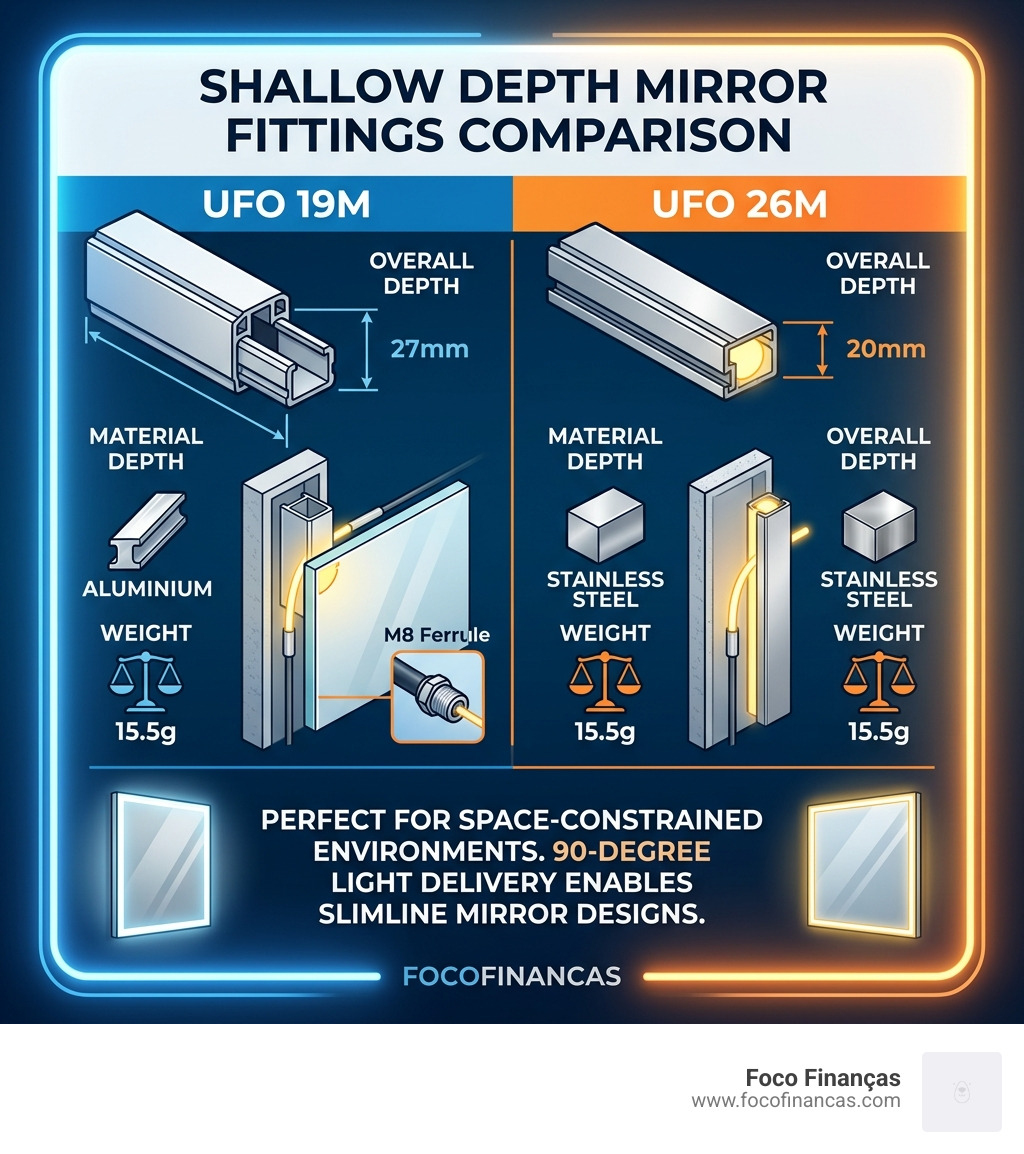
| Specification | UFO 19M | UFO 26M |
|---|---|---|
| Overall Depth | 27mm | 20mm |
| Material | Aluminium | Stainless Steel |
| Weight | 15.5g | 15.5g |
| Beam Angle | 45° | 45° |
| Fiber Size Support | 2mm to 6mm | 2mm to 6mm |
| Key Feature | Glazed front (dustproof) | Ultra-shallow profile |
The UFO 26M is the “skinny legend” of the group, requiring only 20mm of depth. If you are creating a smart mirror frame a diy guide, using these fittings allows you to keep the frame profile incredibly slim.
For those who prefer an all-in-one solution, the MK-L680 Optical fiber lighting kit is a popular starting point. While often used for star ceilings, these kits are perfect for DIY mirror projects because they include the LED light engine and hundreds of PMMA fiber strands of varying diameters (0.75mm to 1.5mm). This variety allows you to create a “shimmer” effect or a more solid border depending on how you group the fibers.
Applications and Benefits of Fiber Optic Mirror Fittings
Why choose fiber optic mirror lighting over a standard backlit LED mirror? The answer usually comes down to three things: safety, aesthetics, and sensory benefits.
In sensory rooms, fiber optics are the gold standard. Because the strands carry only light and no electricity, they are “inherently safe to touch.” Children can hold the glowing fibers, wrap them around their fingers, or lean against the mirror without any risk of shock or heat burns. This encourages tactile exploration and provides calming visual stimulation that can improve mood and attention.
From a technical standpoint, the benefits are equally impressive. Because the light source (the illuminator) is separate from the mirror, there is zero heat transfer to the glass. This prevents the “fogging” issues or adhesive degradation that can happen with cheap LED strips. Furthermore, systems like those detailed by Fiber Optic Light Sources / Illuminators – Fiberoptics Technology Inc. are designed for extreme durability, often used in medical environments where failure isn’t an option.
Whether you are working on a smart-mirror-project-for-tight-budgets or trying to decide mirror-mirror-on-the-wall-which-backlit-smart-mirror-beats-them-all, fiber optics offer a high-end, professional finish that standard LEDs struggle to match.
Installation and Control of Fiber Optic Systems
Installing fiber optic mirror lighting requires a bit of planning regarding “breathing room.” While the fibers themselves can be tucked almost anywhere, the illuminator needs ventilation.
For example, a high-output unit like the FL5200 (found in Our Latest Catalogue ) consumes about 120W of power. While it is incredibly bright, it generates internal heat that must be exhausted. Best practices suggest mounting the illuminator with the exhaust vent facing up and ensuring the area is free from obstructions. Despite the power, these units are surprisingly quiet, with acoustic noise levels around 31 dBA—roughly the sound of a quiet whisper.
Control is another area where fiber optics shine. Most modern light engines offer multiple ways to manage your glow:
- DMX Control: Ideal for integrating your mirror into a whole-home automation system or creating synchronized color changes.
- RF Remotes: Simple, handheld controllers that let you change colors or brightness from across the room.
- USB Programming: Some units, like the FL5200, allow you to plug into a computer to program custom color cycles and patterns.
When you are setting up your smart-mirror-with-smart-lights, consider where you will hide the illuminator. Common spots include a nearby vanity cabinet, a recessed wall niche, or even the ceiling crawlspace. As long as the fibers can reach the mirror, the light source can be several meters away.
Frequently Asked Questions about Mirror Illumination
How does fiber optic lighting differ from traditional LEDs?
The main difference is the separation of the light source. In a traditional LED mirror, the “bulbs” are right behind the glass. In a fiber optic mirror lighting system, the light is generated in a remote box (the illuminator) and “piped” to the mirror via glass or plastic fibers. This means no heat at the mirror, no electrical components near water (great for bathrooms!), and much easier maintenance since you only ever have to service the remote box, not the mirror itself.
Are fiber optic mirror lights safe for sensory rooms?
Absolutely. In fact, they are the preferred choice for therapeutic environments. Because PMMA fibers contain no electricity and produce no heat, they are safe for children and adults to touch and manipulate. They provide a mesmerizing, calming glow that is excellent for “cause-and-effect” learning when paired with interactive controllers.
What maintenance is required for these systems?
Very little! Most LED illuminators are rated for 36,000 to 50,000 hours of use. Unlike halogen systems, there are no lamps to change. The only real maintenance involves occasionally dusting the vents of the illuminator to ensure proper airflow and wiping the mirror fittings. If you use a glazed fitting like the UFO 19M, even dust ingress into the fiber ends is prevented.
Conclusion
At Foco Finanças, we believe that the right technology can turn a simple home project into a luxury experience. Fiber optic mirror lighting is the perfect example of this. It combines safety, energy efficiency, and a stunning aesthetic that traditional lighting simply can’t replicate.
Whether you are building a calming sensory space or a high-tech smart mirror, choosing quality components like UFO fittings and high-output LED illuminators ensures your project will shine for years to come. If you’re ready to start your build, check out our guide on smart-mirror-with-smart-lights-2 or Explore Hardware Solutions to find the perfect parts for your vision.
