
What Is a Heavy Duty Mirror Automator — and Do You Actually Need One?
A heavy duty mirror automator is an industrial control system that combines precision actuators, characterized valve technology, and automated motion control to achieve consistent, high-gloss mirror finishes at scale. Whether you’re sourcing industrial mirror mounts, evaluating automated polishing machines, or upgrading a smart mirror installation, here’s a quick breakdown:
Top heavy duty mirror automator types at a glance:
| Type | Best For | Key Spec |
|---|---|---|
| Pneumatic V-Control actuators | Flow and steam control | Up to 500 psi liquid, 300 psi steam |
| Electric Series 70 actuators | Precision positioning | NEMA 4X, IP66 rated |
| Automated buffing machines | Sheet metal mirror finishing | Ra < 0.1um roughness |
| CNC glass cutting machines | Automotive mirror production | ±0.20mm precision, 6,500 pcs/8h |
| Heavy duty cleat mounts | Wall-mounted mirror installations | 100 lbs per foot rated |
The term “mirror automator” covers a surprisingly wide range of products — from industrial valve actuators used in manufacturing processes, to fully automated polishing machines the size of a small room, to the mounting hardware that keeps heavy mirrors securely on your wall.
What connects them all is a need for precision, durability, and repeatability under demanding conditions.
For tech-savvy homeowners, the most relevant piece of this puzzle is usually the mounting and control side — getting a heavy mirror to stay put, tilt, or integrate with a smart home system without complex wiring headaches. For industrial buyers, the focus shifts to flow control valves, actuator performance, and surface finish quality.
This article walks through both worlds clearly.
Engineering the Heavy Duty Mirror Automator for Precision
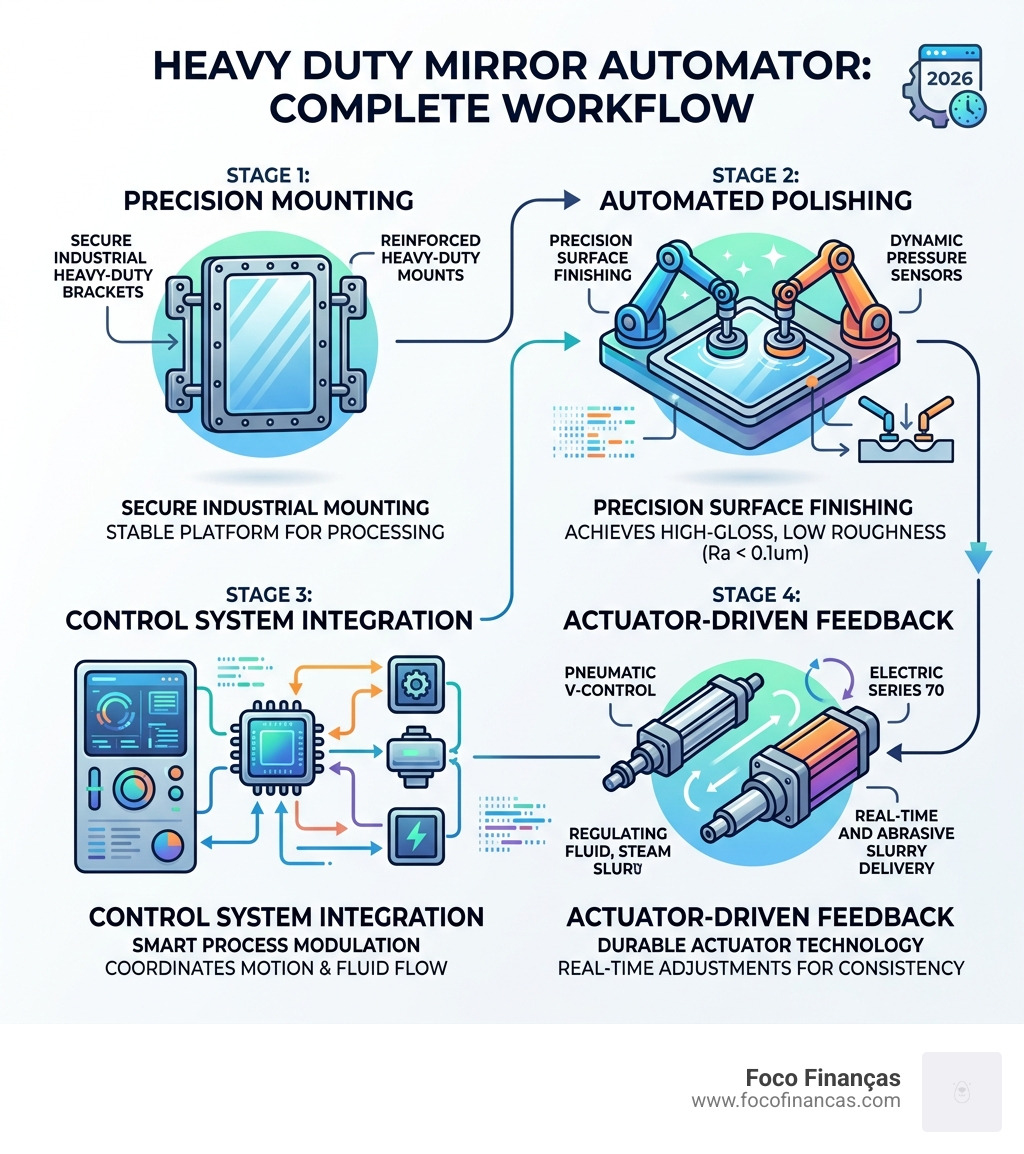
When we talk about a heavy duty mirror automator in an industrial context, we are often referring to the sophisticated control valves and actuators used to manage the fluids, steam, and abrasive slurries required to create a perfect reflection. High-end systems, like the V-Control Series, utilize both pneumatic and electric actuators to ensure that the polishing process is as smooth as the glass itself.
These systems are the unsung heroes of the manufacturing floor. They don’t just “turn on”; they modulate. In high-gloss finishes, even a tiny fluctuation in pressure or flow can result in a visible streak or “haze” on the mirror surface. By using advanced Essential Materials for Your Smart Mirror and industrial-grade components, manufacturers can maintain the tight tolerances required for modern optics.
Characterized V-Balls in a Heavy Duty Mirror Automator
The secret sauce of precision flow control lies in the geometry of the valve. Standard ball valves are great for simple on/off tasks, but for a heavy duty mirror automator, we need “Characterized V-Balls.” These aren’t your average hardware store valves. They feature precision-cut ports in various angles:
- 15° and 30° V-Ports: Ideal for very low flow and high-precision throttling.
- 60° and 90° V-Ports: Better for higher flow rates while maintaining control.
- Slotted Ports: Used when linear flow is the priority.
These V-balls offer an incredible rangeability—often starting at a minimum of 200:1 and sometimes exceeding 800:1. This means the system can control a tiny trickle of fluid just as accurately as a firehose-level blast. Furthermore, they meet Class VI standards for bubble-tight shutoff, ensuring that when the machine says “stop,” not a single drop of polishing slurry leaks through to ruin a fresh workpiece.
Actuator Performance and Low Hysteresis
Precision is nothing without responsiveness. This is where Series 6A electro-pneumatic positioners and Series 70 electric actuators come into play. A major hurdle in automation is “hysteresis”—the lag between a command being sent and the machine actually moving. A high-quality heavy duty mirror automator eliminates this lag through adaptive control.
These units are incredibly efficient. For instance, some electro-pneumatic positioners boast a minimal air consumption rate of less than 0.00035 scfm at 80 psi. They are built to survive the harshest environments, often carrying NEMA 4X and IP66 protection ratings. This means they are dust-tight and protected against powerful jets of water—perfect for a polishing floor where water and grit are everywhere.
Industrial Buffing and Cutting Solutions
Moving from the valves to the machines themselves, the scale of a heavy duty mirror automator can be massive. We aren’t just talking about a handheld buffer; we’re talking about machines that fill entire rooms to process giant sheets of stainless steel or glass.
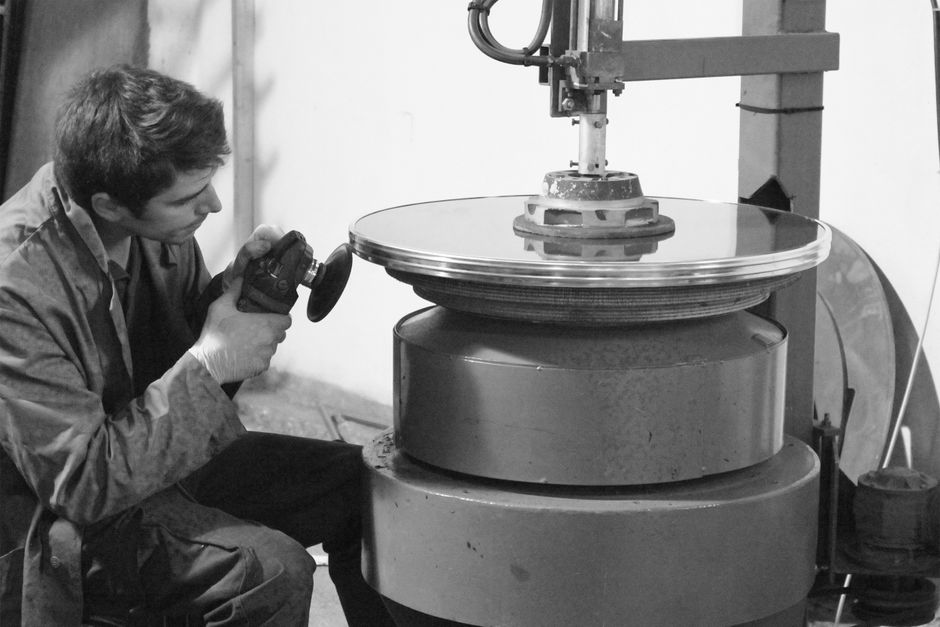
In metal finishing, achieving a roughness of Ra < 0.1um is the gold standard. To get there, machines use a combination of cloth emery discs and precise frequency speed control. These systems can process between 6 to 15 square meters per hour, turning dull industrial plates into mirrors clear enough to shave in.
Automated Glass Processing for Automotive Mirrors
If you’ve ever wondered how the mirror in your car gets its perfect shape, the answer is high-speed CNC automation. Modern glass cutting machines for auto-dimming rear-view mirrors are marvels of efficiency. These systems can churn out 6,500 pieces every 8 hours with a precision of ±0.20mm.
These machines feature automatic pressure adjustment, which is vital because glass thickness can vary slightly. If the pressure isn’t perfect, the glass chips. For those looking to bring a bit of this tech home, understanding the mounting requirements is the next step. You can learn more about the physical setup in our guide on How to Build and Install a Wall Mounted Smart Mirror.
High-Efficiency Buffing for Sheet Metal
For large-scale industrial applications, sheet metal buffing machines (often measuring 4000x3200x1800mm) provide the muscle. These units use a “Mirror Polished Metal Buffing” technique that relies on a series of rotating spindles—often spinning at 2800 r/min. Because these machines handle heavy workpieces, they require robust internal components to withstand the constant vibration and heat generated during the polishing cycle.
Heavy Duty Mirror Automator Mounting and Durability
Whether you are installing a 100-pound mirror in a hotel lobby or a 400-pound sheet of polished steel in a corporate office, the mounting hardware is just as “heavy duty” as the automation electronics.
| Feature | Characterized Ball Valve | Traditional Globe Valve |
|---|---|---|
| Weight | Lightweight / Compact | Heavy / Bulky |
| Cost | Economical | Expensive |
| Shutoff | Class VI (Bubble-tight) | Often Class IV or V |
| Flow Capacity | High | Moderate |
| Maintenance | Low (Self-cleaning) | High (Prone to clogging) |
For most modern setups, we recommend ISO 5211 mounting standards. This ensures that the actuator and the valve (or the mirror mount) fit together perfectly without custom-machined brackets. For safety-critical environments, look for API 607 fire-safe ratings, which ensure the system won’t fail catastrophically during a fire.
Specialized Hardware for Heavy Duty Mirror Automator Systems
In a heavy duty mirror automator, the “Smart Stem” is a critical innovation. These stems feature live-loaded seals that self-adjust as they wear down. This prevents leaks and keeps the automation running smoothly for years without manual intervention.
When it comes to hanging the actual mirror, we often look to heavy-duty cleats. These are rated for 100 pounds per foot. So, a 48-inch cleat can safely support a 400-pound mirror! To ensure your project stays on the wall, it is essential to Choose the Right Mounting Hardware for Your Smart Mirror to match the weight and the wall type.
Handling High Pressure Drops and Steam
Industrial mirror manufacturing often involves high-pressure steam for cleaning or heating chemical baths. A true heavy duty mirror automator must be able to handle liquid pressure drops of up to 500 psi and steam up to 300 psi.
To survive these conditions, engineers use advanced materials:
- TFM 1600: A second-generation PTFE that offers better pressure resistance.
- PEEK: A high-performance plastic for extreme temperature and chemical resistance.
- Cavitation Prevention: By installing V-ports downstream, the system can manage the energy of the fluid to prevent “pitting” or damage to the valve body.
Niche Applications: From Zoo Enrichment to DIY Grinding
The term “heavy duty” takes on a whole new meaning when you’re designing for an orangutan or a telescope.
Large Animal Enrichment Systems
In zoos, mirrors are used for environmental stimulation. However, a standard glass mirror would last about five seconds with a curious gorilla. Instead, a heavy duty mirror automator approach is used to create shatterproof enrichment panels. These typically measure 24″ x 48″ and are constructed from polycarbonate with a stainless steel frame. They are designed to be indestructible while providing a clear reflection for the animals.
Amateur Telescope Mirror Fabrication
On the DIY side, the “Mirror-o-Matic” represents the pinnacle of home-built mirror automation. These machines allow hobbyists to grind their own concave telescope mirrors up to 17.5 or 20 inches in diameter. Interestingly, these are often built from 3/4 inch plywood and powered by simple 1/3 hp motors. Despite their humble materials, they use stationary drip pans and sophisticated push-rod assemblies to achieve optical perfection that rivals professional observatories.
Frequently Asked Questions about Mirror Automation
What is the rangeability of a heavy duty mirror automator valve?
In the context of industrial control, rangeability is the ratio of the maximum flow to the minimum controllable flow. For a heavy duty mirror automator using characterized V-balls, the rangeability is typically a minimum of 200:1. In high-performance setups, this can exceed 800:1, allowing for incredibly fine adjustments during the polishing process.
How do V-port balls prevent cavitation in mirror manufacturing?
Cavitation occurs when vapor bubbles form and collapse in a fluid, causing physical damage to the equipment. By using a V-port ball and installing it in a “downstream” orientation, the pressure drop is managed more gradually. Some designs also use slotted ports to break up the flow into smaller streams, which significantly reduces noise and vibration.
What safety standards apply to industrial mirror actuators?
Safety is paramount in automation. Industrial actuators often meet NEMA 7&9 standards for explosion-proof environments (essential if using flammable polishing compounds). They also comply with EExd IIC T4/T5/T6 international standards. For bidirectional shutoff, look for valves that meet FCI 70-2 Class VI requirements.
Conclusion
Whether you are building a high-tech factory or a high-end home, the heavy duty mirror automator represents the intersection of brute strength and delicate precision. From the V-port valves that control the flow of polishing slurries to the heavy-duty cleats that keep your finished product securely mounted, every component plays a role in achieving that perfect, high-gloss finish.
At Foco Finanças, we believe that understanding the “bones” of your project is the first step to success. By integrating adaptive control systems and using the right materials, you can create a system that is both durable and incredibly smart. If you’re ready to start your own project, check out our Creating a Smart Mirror Frame: A DIY Guide for more inspiration.
For more information on industrial hardware and smart home integration, visit us at https://www.focofinancas.com/.
