
Why Your Builder-Grade Bathroom Mirror Is Costing You More Than You Think
Bathroom mirror DIY projects are one of the fastest, cheapest ways to upgrade a bathroom — and the options below cover the most popular methods at a glance:
- Stick-on wood frame — Attach pre-cut 1×4 boards directly to the mirror using Command Strips. No power tools needed. Cost: ~$15.
- Glued molding frame — Apply decorative molding around the mirror edge with Liquid Nails adhesive. Cost: $15–$50.
- Built-and-hung frame — Build a mitered wood frame separately, finish it, then mount it over the mirror. Most polished result. Cost: $30–$50.
Most bathrooms come with the same thing: a plain, frameless slab of glass glued to the wall. No character. No style. Just… glass.
The good news? You don’t need a full renovation to fix it.
A simple frame can completely change how a bathroom feels — and it can cost as little as $15 and a couple of hours of your time. That’s not an exaggeration. Many homeowners have reported that framing an existing mirror was the single change that made their whole bathroom feel finished and intentional.
Whether you’re prepping a home to sell, refreshing a rental, or just tired of staring at a boring builder-grade mirror every morning, this guide walks you through everything — from no-tool beginner methods to more advanced wood-frame builds.
Essential Tools and Materials for Your Bathroom Mirror DIY
Before we dive into the sawdust and glue, we need to gather our supplies. The beauty of a Bathroom mirror DIY is that the barrier to entry is incredibly low. You don’t need a professional workshop to achieve professional results. In fact, many successful DIYers have completed this project for under $50, often using materials already lying around the garage.
The Essential Tool Kit
Depending on which method you choose, your tool list will vary. However, for a standard wood frame build, we recommend having the following on hand:
- Miter Saw or Miter Box: Essential for those crisp 45-degree corner angles.
- Kreg Jig: If you want a rock-solid frame that won’t separate over time, pocket holes are our best friend.
- Drill and Driver: For assembling the frame components.
- Tape Measure: Precision is everything here.
- Level: To ensure your hard work doesn’t look crooked every time you brush your teeth.
- Safety Glasses: Because flying wood chips and glass are a bad combination.
- Sander or Sandpaper: 120 and 220 grit are usually sufficient for smoothing out pine or MDF.
- Painter’s Tape: This acts as an “extra set of hands” to hold pieces in place while adhesive cures.
Selecting the Right Wood and Adhesive
Choosing your materials is where you decide the “vibe” of your bathroom.
- Select Pine: This is our top choice for a rustic or stained look. It’s affordable, lightweight, and easy to work with.
- MDF (Medium Density Fiberboard): If you plan on painting your frame a solid color (like white or navy), MDF is a great, stable option. However, be sure to seal it well, as MDF can swell if it absorbs too much bathroom moisture.
- Decorative Molding: For a more “glam” or traditional look, baseboards or crown molding can be repurposed as mirror frames.
When it comes to sticking things to glass, not all glues are created equal. We generally use Liquid Nails (specifically the “Mirror” or “Clear” versions) or Mirror Mastic. These are formulated not to damage the silver backing of the mirror. For a less permanent solution—perfect for renters—Command Strips are a game-changer.
If you’re looking to integrate technology into your vanity setup, you might even consider how these frames can house lighting for a smart-mirror for makeup setup.
No-Power-Tool Options for Beginners
We know that not everyone owns a miter saw. If the thought of power tools makes you nervous, don’t worry! You can still achieve a stunning Bathroom mirror DIY.
- Stick-on Frames: You can buy pre-finished molding that comes with adhesive backing.
- The Miter Box Method: A $15 plastic miter box and a hand saw can cut 1×4 boards just as well as a power saw—it just takes a little more “elbow grease.”
- Butt Joints: Instead of cutting tricky 45-degree angles, you can simply cut your boards straight and “butt” them against each other. This creates a clean, modern, or farmhouse look without the stress of perfect miters.
- Command Strip Method: By using Command Strips, you can avoid glue entirely. This allows you to build the frame on the floor, finish it, and simply “click” it onto the mirror surface.
How to Measure and Prep Your Mirror for a Custom Frame
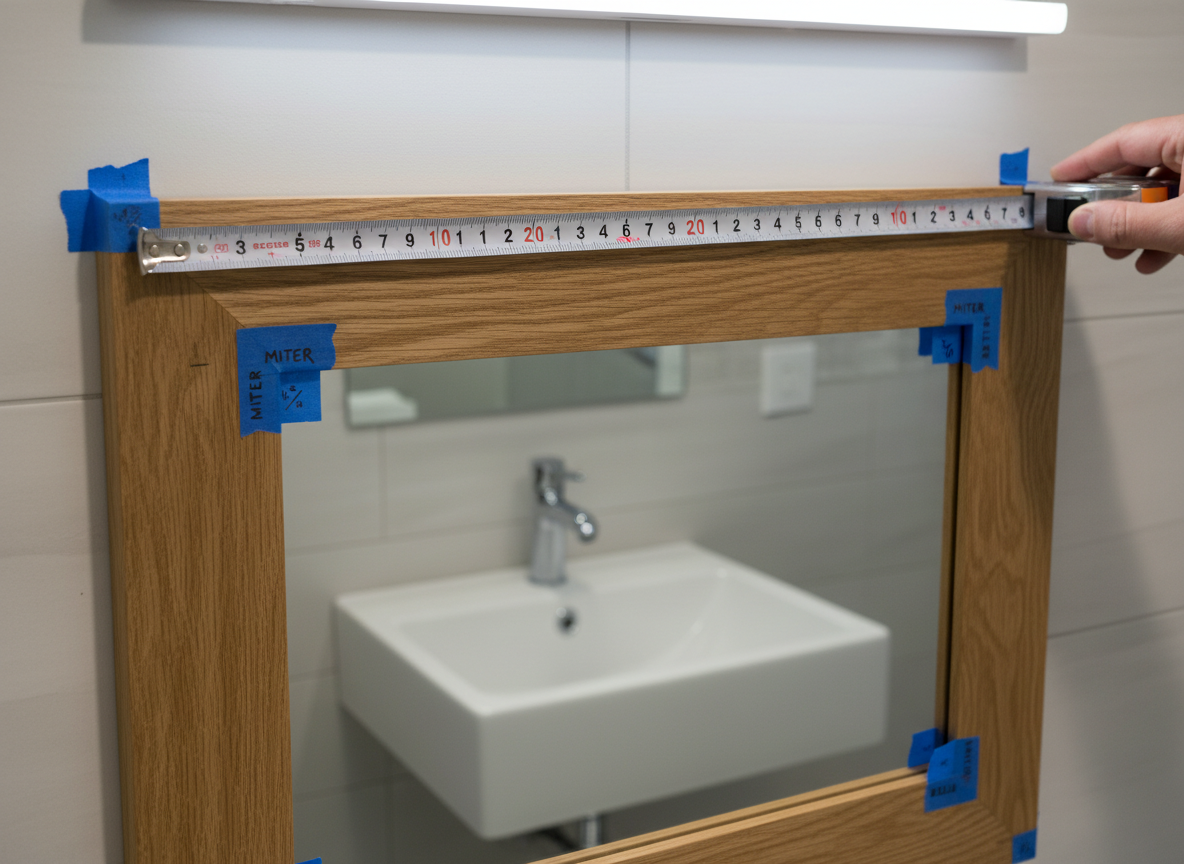
Measurements are the “make or break” moment of this project. If you’re off by even a quarter of an inch, your frame might show the ugly edge of the mirror or fail to cover the clips.
The Golden Rule of Measuring
When we measure for a frame that sits on top of the glass, we don’t just measure the glass itself. We need to account for the “overlap.”
- Measure the total width and height of the mirror.
- Decide on your overlap: We usually recommend the frame overlaps the mirror by about 1/2 inch on all sides. This ensures you don’t see the mirror’s edge in the reflection.
- Account for the wall: If your mirror is “wall-to-wall,” your measurements must be exact. If there is space on the sides, you have a bit more wiggle room.
Dealing with Mirror Clips
Most builder-grade mirrors are held up by plastic clips. You have two choices:
- The Chisel Technique: Mark where the clips hit your wood boards and use a chisel or a Dremel tool to notch out a small “pocket” on the back of the wood. This allows the board to sit flush against the glass while the clip hides inside the wood.
- Replace the Clips: Some DIYers replace bulky plastic clips with flat metal ones that are easier to hide under the frame.
Surface Preparation
Adhesives hate dust and hairspray. Before you even think about attaching your frame, clean the perimeter of the mirror thoroughly. We recommend using rubbing alcohol. It strips away oils and cleaning product residue, ensuring a bond that will last for years. This preparation is even more critical if you are planning a more high-tech upgrade, like a diy-bathroom-smart-mirror, where stability is paramount.
Step-by-Step Guide to Building Your Bathroom Mirror DIY Frame
Now for the fun part: the assembly. We’ve broken this down into a simple process that balances durability with aesthetics.
| Feature | Liquid Nails (Mirror Mastic) | Command Strips |
|---|---|---|
| Permanence | Permanent | Removable / Renter-friendly |
| Dry Time | 24 Hours | Instant (but let strips “set” 24h) |
| Ease of Use | Requires tape/support while drying | Very easy “click” system |
| Best For | Heavy wood frames | Lightweight molding or 1x4s |
Step 1: Cutting the Angles
If you’re going for the classic mitered look, set your saw to 45 degrees. Remember: the inside measurement of your frame should be slightly smaller than your mirror to create that necessary overlap.
Pro Tip: Always cut your boards a tiny bit longer than you think you need. You can always shave off a sliver of wood, but you can’t add it back!
Step 2: Sanding and Pre-Finishing
Do not wait until the frame is on the mirror to paint or stain it. Sand your boards with 220-grit sandpaper until they feel like silk.
The Reflection Management Trick: This is the most common mistake in Bathroom mirror DIY. Because the mirror reflects the back of the frame, you must paint or stain the inside edges and about an inch of the back side of the boards. If you don’t, you’ll see a line of raw, unfinished wood in the reflection every time you look in the mirror.
Step 3: Assembling the Frame Components
We prefer to assemble the frame on a flat surface (like a garage floor) before taking it to the bathroom.
- Use wood glue on the mitered corners.
- Reinforce the corners with pocket hole screws (using a Kreg Jig) or flat L-brackets on the back.
- Use a speed square to ensure the frame is perfectly “square” (90-degree corners). If the frame is wonky on the floor, it will be a nightmare on the wall.
For more inspiration on what these frames can look like once assembled, check out these bathroom-smart-mirror-ideas.
Step 4: Attaching the Frame to the Glass
Once your frame is assembled, finished, and dry, it’s time to mount it.
- Apply Adhesive: If using Liquid Nails, apply a “wavy line” pattern to the back of the frame. Stay about an inch away from the edges to prevent the glue from “oozing” out and becoming visible in the reflection.
- The Mirror Placement: Carefully press the frame onto the mirror.
- Support: Use painter’s tape to secure the frame to the wall/mirror while the glue cures. For heavy frames, you might even need to prop a couple of 2x4s against it to hold it tight overnight.
- The 24-Hour Rule: Don’t touch it! Let the adhesive cure for a full 24 hours before removing the tape.
Creative Styles: From Rustic Wood to Modern Grid Designs
One of the reasons we love a Bathroom mirror DIY is the sheer variety of styles you can achieve. You aren’t limited to what’s in stock at the big-box store.
The Modern Grid (Window Pane) Look
This is a massive trend right now. By using thin strips of wood (like lath or lattice strips) and crossing them over the mirror, you can create a “window pane” or grid effect.
- Materials: 1/4 inch thick wood strips.
- Method: Paint them matte black and glue them in a grid pattern. It instantly makes a large, boring mirror look like an expensive custom piece.
Farmhouse and Rustic
For that Joanna Gaines-inspired look, use 1×4 select pine boards.
- Finish: Use a “weathered oak” or “dark walnut” stain.
- Details: Add black metal L-brackets to the corners for an industrial, “reclaimed” feel.
The Floating Shelf Method
If you’re feeling adventurous, you can skip the traditional frame and go for a floating shelf.
- Use a 2×4 board and cut a slit down the length of it using a table saw or router.
- Mount the 2×4 to the wall studs and slide the mirror into the slit. It creates a minimalist, high-end look that also provides a small ledge for your toothbrush or a candle.
Achieving a Professional Finish
The difference between a “DIY project” and a “custom renovation” is in the finishing touches.
- Wood Filler: Always fill your nail holes and corner gaps with wood filler. Once dry, sand it flush.
- Pre-Stain Conditioner: If using pine, this is a must. It prevents the stain from looking “blotchy.”
- Polyurethane: Bathrooms are humid. Protect your work with at least two coats of polyurethane. We prefer a satin or matte finish for a modern look, but gloss can work well for “glam” styles.
Common Mistakes to Avoid in Your Bathroom Mirror DIY Project
We’ve seen it all—and we’ve made some of these mistakes ourselves! Learn from our experience to ensure your project goes smoothly.
- Ignoring the Silvering: Using the wrong adhesive (like standard superglue) can eat away at the mirror’s backing, leaving black spots. Always use mirror-safe adhesive.
- The “Ooze” Factor: If you apply too much glue near the inner edge, it will squeeze out. Because it’s against a mirror, you’ll see twice as much of it! Keep your glue lines centered on the wood.
- Forgetting the Back Edge: We mentioned this before, but it’s worth repeating. Paint the back of the inner edge! If you don’t, the reflection will show a strip of raw wood that screams “I did this myself in twenty minutes.”
- Trapping Moisture: If you seal the frame too tightly against the wall, moisture can get trapped behind the wood, leading to mold. Leaving a tiny, microscopic gap or using moisture-resistant MDF can help.
- Measurement Hubris: “Measure twice, cut once” is a cliché for a reason. Always hold your cut boards up to the mirror before you put glue on them.
Frequently Asked Questions about DIY Mirror Framing
How do I handle mirror clips without removing the mirror?
As we discussed, the easiest way is to notch out the back of the wood. Using a wood chisel, you can carve a small indentation where the clip sits. This allows the frame to sit perfectly flat against the glass. Alternatively, if your frame is thick enough (like a 1×4), it might just sit on top of the clips without any modification.
What is the cheapest way to frame a bathroom mirror?
The absolute cheapest method is using MDF baseboard molding and Command Strips. You can often find “remnant” molding at hardware stores for a few dollars. Combined with a small container of “oops” paint (mismatched paint sold at a discount), you can finish this project for under $15.
Can I frame a mirror in a high-moisture bathroom?
Yes, but you must be diligent about your finish. Use a high-quality primer and at least two coats of polyurethane or exterior-grade paint. This prevents the wood from warping or growing mold. If your bathroom has poor ventilation, we recommend using PVC molding, which looks just like wood but is 100% waterproof.
Conclusion
Elevating your home doesn’t have to mean spending thousands on a contractor. A Bathroom mirror DIY is the perfect “weekend win”—a project that is low-risk, high-reward, and incredibly satisfying. By adding a simple frame, you’re not just adding wood to a wall; you’re adding character, value, and a sense of “finished” design to your most-used room.
At Foco Finanças, we believe that smart home ownership is about making high-impact changes that fit your budget. Whether you choose a rustic 2×4 floating shelf or a sleek black grid design, your “new” mirror will be a testament to your creativity and DIY spirit.
Ready to tackle your next room? Upgrade your home with our build guides for more step-by-step instructions on transforming your space! Happy framing!
