
Why a Precision Mirror Cooling Device Belongs in Your Industrial Lab
Precision mirror cooling devices are specialized instruments that chill a polished mirror surface until moisture from a gas sample condenses on it — giving you a direct, highly accurate dew point or frost point reading.
Quick answer — top precision mirror cooling devices to consider:
| Device | Best For | Key Accuracy |
|---|---|---|
| Michell Optidew | Industrial humidity control | ±0.15°C dew point |
| Michell S8000 RS | Metrology & calibration labs | ±0.1°C, down to -90°C frost point |
| DewMaster | Lab & industrial, multiple enclosures | NIST-traceable, drift-free |
| Dew Star Series (SHINYEI) | Calibration, clean rooms, corrosive gas | Peltier-cooled, ACCU-STAR maintenance |
If you need stable, long-term humidity measurement without sensor drift, chilled mirror technology is the gold standard — and has been used as a NIST-referenced humidity transfer standard in metrology labs for decades.
Other humidity sensors drift over time and need frequent recalibration. Chilled mirror devices don’t — because they rely on a fundamental physical principle (condensation) rather than a chemical or capacitive response. That makes them uniquely reliable for high-stakes industrial and lab environments.
The tradeoff? They require more careful handling, have slower response times at very low humidity levels, and aren’t suitable for hazardous or reactive gas environments. Understanding which device fits which application is what this guide is all about.
The Science of the Precision Mirror Cooling Device
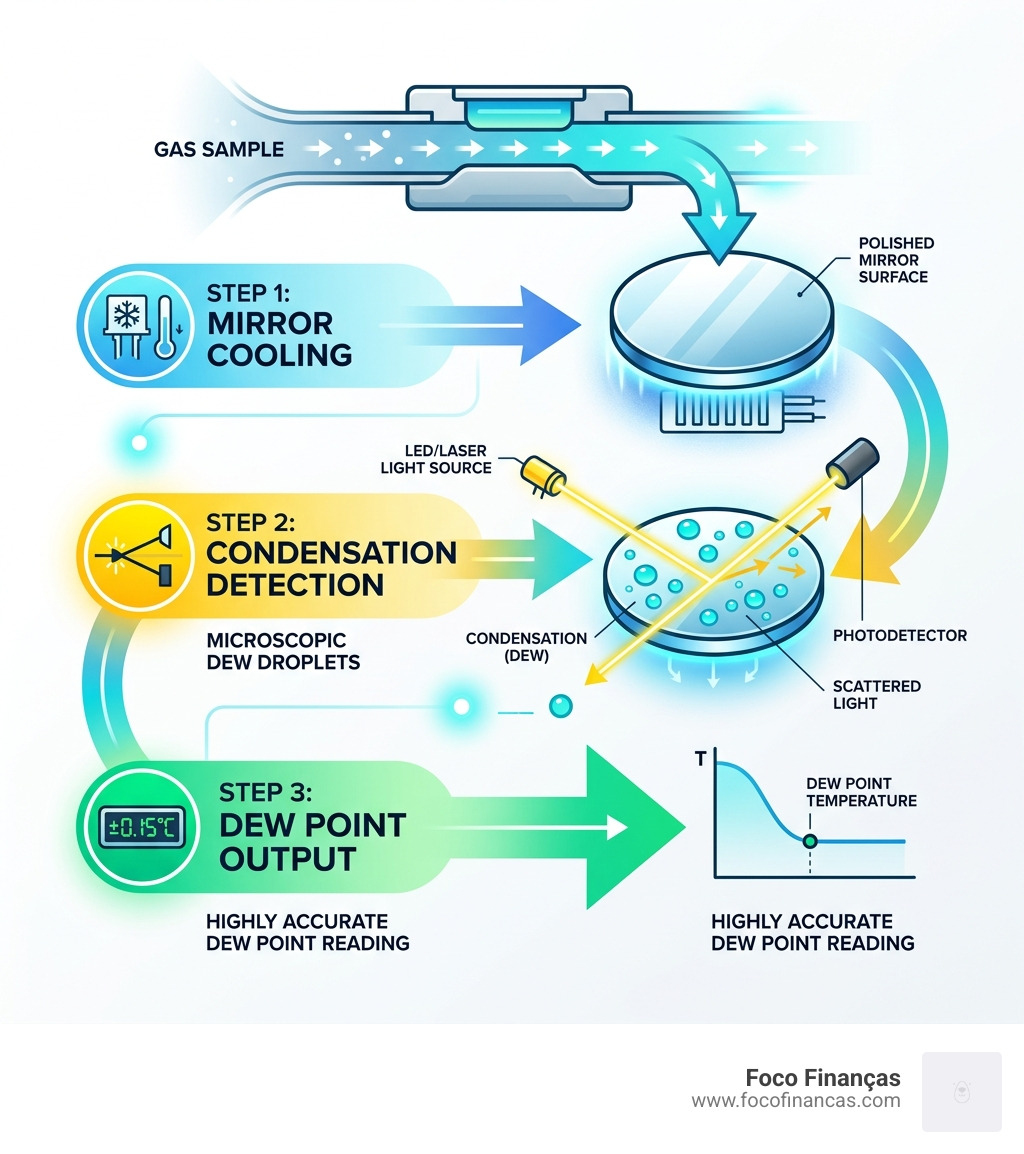
At its heart, a precision mirror cooling device operates on a deceptively simple principle: the chilled mirror method. We take a sample of gas and pass it over a highly polished metal mirror. We then cool that mirror until condensation (dew) or ice (frost) begins to form on the surface.
How do we know exactly when that happens? We use an optical detection system. A laser or LED shines onto the mirror, and a photodetector measures the intensity of the reflected light. When dew forms, it scatters the light, and the drop in reflected intensity signals the device that we have reached the dew point.
The beauty of this system is that it maintains a state of dynamic equilibrium. The device adjusts the cooling to ensure the rate of condensation exactly matches the rate of evaporation. At this precise moment, the temperature of the mirror—measured by an incredibly accurate 4-wire Platinum Resistance Thermometer (PRT)—is the actual dew point of the gas.
For a deeper dive into the technical architecture of these systems, check out a-comprehensive-guide-on-a-smart-mirror-cooling-system.
This method allows for staggering levels of precision. Leading devices like the Michell Optidew offer an accuracy of ±0.15°C across a range of -40 to +120°C. Because this is a primary measurement based on vapor pressure and temperature, it doesn’t suffer from the “drift” that plagues capacitive sensors. While other sensors might give you a “guestimate” based on how a chemical polymer reacts to water, the precision mirror cooling device gives you the cold, hard facts.
Optimizing the Precision Mirror Cooling Device for Low Frost Points
When we move into the realm of ultra-dry gases—think semiconductor manufacturing or high-purity gas production—we aren’t just looking for dew; we are looking for frost. Measuring frost points down to -90°C (which is about 95.4 parts per billion by volume, or ppbV) requires some serious engineering.
Most standard units use Peltier thermoelectric elements for cooling. These are solid-state heat pumps that move heat away from the mirror. However, a two-stage Peltier device is typically limited to cooling about 65°C below the heat sink temperature. If your lab is at 25°C, your frost point measurement might bottom out around -40°C.
To go lower, we look toward advanced optics and specialized cooling. The Michell S8000 RS, for instance, uses a unique optical system to achieve -90°C without needing external cooling like liquid nitrogen. But in the most extreme scientific settings, such as synchrotron beamlines, even that isn’t enough.
For these high-heat-load environments, researchers often turn to liquid nitrogen. You can read more about the Scientific research on liquid-nitrogen-cooled silicon mirrors to see how these systems handle extreme thermal stability. In these setups, the silicon substrate must be cooled to around 125 K to maintain its shape under intense X-ray bombardment, where even a tiny thermal deformation would ruin the experiment.
Comparing Cooling Technologies for High-Performance Mirrors
Not all cooling methods are created equal. Depending on whether you are measuring humidity in a pharmaceutical plant or reflecting a high-power laser in a research facility, your choice of precision mirror cooling device will vary wildly.
| Cooling Method | Typical Range/Capability | Best For | Key Advantage |
|---|---|---|---|
| Peltier (Thermoelectric) | Down to -40°C (standard) or -90°C (advanced) | Industrial labs, calibration | Compact, no moving parts, vibration-free |
| Liquid Nitrogen (LN2) | Cryogenic (down to 80-125 K) | Synchrotrons, X-ray beamlines | Handles massive heat loads, minimal slope error |
| Water Cooling | Ambient to +120°C | High-power lasers, EUV lithography | High heat removal capacity, cost-effective |
| Two-Phase Fluids | Passive heat pipe action | Satellite optics, laser reflectors | Passive, vibration-free, lightweight |
In high-precision applications like EUV lithography, we have to worry about vibrations. If the cooling fluid is moving turbulently, it can cause the mirror to shake, which is a disaster when you’re trying to etch patterns only a few nanometers wide.
To solve this, engineers use laminar microchannel flow. By keeping the Reynolds number below 2000 (ideally between 20 and 70), the fluid moves in smooth, predictable streamlines. This prevents vibration while still removing up to 90W of absorbed heat from a collimator mirror.
Another fascinating innovation is the use of two-phase fluids in a foam core. This is a passive cooling method where a liquid evaporates near the mirror face and condenses at the back, using wicking action to return the fluid. It’s essentially a high-tech heat pipe that keeps the mirror “cool under pressure” without any pumps or external power.
Structural Innovations in the Precision Mirror Cooling Device
We’ve talked about how we cool the mirror, but what about the mirror itself? If you cool a piece of metal or silicon unevenly, it warps. In precision optics, a warp of just a few nanometers can be the difference between success and failure.
One of the coolest (pun intended) developments is the cantilevered silicon mirror. By mounting the mirror on a single manifold face, we isolate the optical region from the mounting forces. This design was pioneered for the Advanced Light Source Upgrade (ALS-U). The cantilevered structure ensures that thermal strain is confined to an area away from where the light actually hits.
We also see the rise of topology optimization. This is where computers design the cooling channels to be as efficient as possible. Research has shown that using topology-optimized flow channels can reduce surface shape accuracy errors by 22.96% (improving the RMS from 277.66 nm to 213.79 nm).
Furthermore, these systems are designed with high stiffness in mind. A well-designed cantilevered mirror manifold system can have a first natural frequency of 402 Hz—double the typical design target of 200 Hz—which makes it incredibly resistant to environmental vibrations. You can find more on this in the Research on cooling flow channel enhancement.
Primary Applications in Industrial and Metrology Settings
Where do we actually find these precision mirror cooling devices in the wild? They are more common than you might think.
- Metrology Standards: Because the chilled mirror method is a primary measurement, these devices serve as the “referee” in calibration labs. They are NIST-traceable and used to calibrate less accurate capacitive or resistive sensors.
- Semiconductor Manufacturing: In clean rooms, moisture is the enemy. Even a few parts per billion of water vapor can ruin a batch of wafers. Chilled mirrors provide the trace moisture measurement needed to keep the nitrogen or argon gas streams pure.
- EUV Lithography: Extreme Ultraviolet mirrors absorb about 30% of incident radiation. Without a Liquid cooled mirror for use in lithography, the heat would distort the optics and stop production.
- Automotive Emissions: Testing the humidity of exhaust gases requires a sensor that can handle high temperatures and saturated conditions without failing. Industrial-grade chilled mirrors like the Michell Optidew are built for exactly this.
- Pharmaceutical Packaging: Ensuring that medicines stay dry during the foil-sealing process is critical for shelf life. Precision hygrometers monitor the “dry boxes” where this packaging happens.
- Metallurgical Processes: In carburizing atmospheres used for heat-treating metal, the dew point must be controlled to prevent oxidation. Chilled mirrors provide the long-term stability needed for these 24/7 industrial furnaces.
Maintenance and Calibration for Long-Term Reliability
While a precision mirror cooling device is drift-free, it isn’t maintenance-free. If the mirror gets dirty, the optical system might mistake a speck of dust for a water droplet.
To combat this, modern devices use “Automatic Balance Control” (ABC) or features like SHINYEI’s “ACCU-STAR.” These systems periodically heat the mirror to evaporate all moisture, then re-zero the optics to account for any contaminants that have settled on the surface. It’s like a self-cleaning oven for your humidity sensor.
However, we still recommend an annual calibration to ensure everything is within spec. During this time, the 4-wire PRT is checked against a reference standard to maintain ISO/IEC 17025 certification.
For manual cleaning, many devices include a microscope or a viewing port so you can visually inspect the mirror. If you see salt crystals or oil film, a gentle wipe with a specialized cleaning solution is usually all it takes to restore “as-new” performance.
Pro Tip: Don’t over-clean! Interestingly, a tiny bit of dust can actually help the condensation process by providing “nucleation sites,” which can speed up the response time in very dry conditions.
Frequently Asked Questions about Mirror Cooling
How does a chilled mirror hygrometer achieve drift-free measurements?
Unlike other sensors that rely on a material’s property changing (like electrical resistance), a chilled mirror measures a physical temperature at which a phase change occurs. Since the laws of physics don’t “drift,” the measurement remains stable as long as the mirror is clean and the thermometer is accurate.
Can precision mirror cooling devices be used in hazardous environments?
Generally, no. Because these devices use heating and cooling elements (like Peltiers) and electrical optical systems, they are not typically rated for “Ex” or hazardous areas. If you are working with explosive gases, you’ll need to sample the gas and pipe it into a safe area where the hygrometer is located.
What is the difference between dew point and frost point in mirror cooling?
It’s all about the state of the water. If the mirror is cooled and liquid water forms, we call it the dew point. If the temperature is below freezing and ice crystals form directly from the vapor, we call it the frost point. Most high-end precision mirror cooling devices can automatically detect and distinguish between the two.
Conclusion
At Foco Finanças, we know that precision engineering and thermal management are the backbones of industrial reliability. Whether you are managing a high-tech clean room or a heavy-duty manufacturing plant, choosing the right precision mirror cooling device is an investment in accuracy that pays off through reduced waste and better quality control.
From the rugged Michell Optidew to the ultra-precise S8000 RS, these devices represent the pinnacle of humidity measurement technology. They remind us that sometimes, the best way to handle the pressure of modern industry is to just stay cool.
Ready to upgrade your lab’s capabilities? Explore more hardware solutions to find the tools you need for your next project.
