
Why a Custom Shaped Mirror Is the Easiest Way to Transform Any Room
A custom shaped mirror is exactly what it sounds like: a mirror cut and crafted to a specific shape, size, or design that you choose — not whatever the store happens to stock.
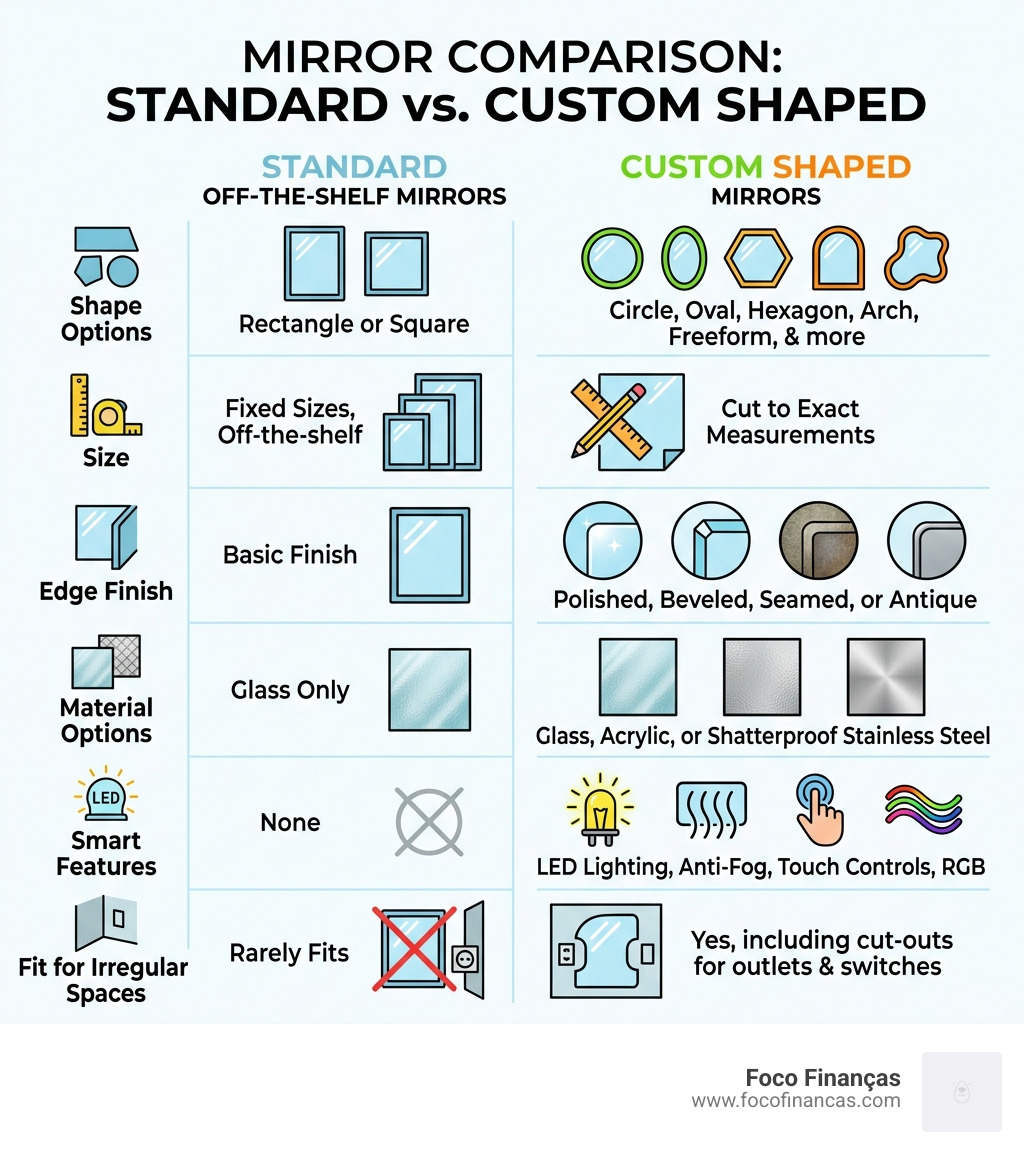
Here’s a quick overview of what makes custom mirrors different from standard ones:
| Feature | Standard Mirror | Custom Shaped Mirror |
|---|---|---|
| Shape options | Rectangle or square | Circle, oval, hexagon, arch, freeform, and more |
| Size | Fixed, off-the-shelf | Cut to your exact measurements |
| Edge finish | Basic | Polished, beveled, seamed, or antique |
| Material | Glass only | Glass, acrylic, or shatterproof stainless steel |
| Smart features | None | LED lighting, anti-fog, touch controls, RGB |
| Fit for irregular spaces | Rarely | Yes, including cut-outs for outlets and switches |
Most people settle for a basic rectangular mirror because it’s easy. But a mirror that fits your exact wall, matches your style, and reflects your personality? That’s a different thing entirely.
Custom mirrors aren’t just decorative. They can make a small room feel larger, bounce natural light into dark corners, and act as a genuine focal point — all while being completely yours.
Whether you want a sleek hexagon above your vanity, a full-wall gym mirror, or a smart mirror with built-in LED lighting and app controls, the options are far more accessible than most people realize.
This guide walks you through everything — shapes, materials, tech features, ordering, and installation — so you can make a confident, informed choice.
The Art of the Custom shaped mirror: Beyond Standard Rectangles
When we think of mirrors, our minds often go straight to the four-cornered glass we see in every hallway. But the true beauty of a custom shaped mirror lies in its ability to break those boundaries. Moving beyond standard rectangles allows us to treat a mirror as a piece of functional art.
Modern precision cutting technology, such as laser cutting and water-jet systems, means we are no longer limited by straight lines. We can now incorporate non-symmetrical patterns and organic curves that mimic nature or bold geometric shapes that define a room’s architecture. Whether you are looking for a sharp rhombus to add edge to a modern office or a soft, flowing silhouette for a spa-like bathroom, the possibilities are virtually endless.
One of the most important things to understand when moving away from standard shapes is dimension tolerance. High-quality manufacturers typically maintain a tolerance of +/- 1 mm, ensuring that even the most complex shapes fit perfectly into their designated spots. However, keep in mind that non-standard shapes often require a “pattern-cutting charge.” This is because the fabricator must create a specific template or digital file to guide the cutting machine, ensuring the final product matches your vision exactly.
Popular Geometric and Organic Shapes
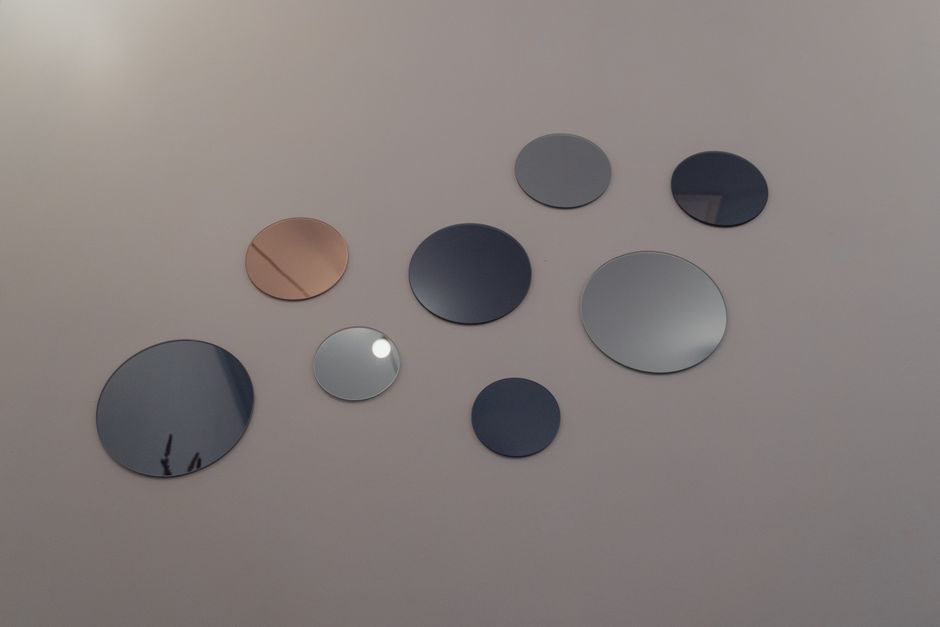
If you aren’t ready for a completely freeform design, there are several “standard” custom shapes that offer a significant upgrade over a basic rectangle without needing a complex custom pattern. These include:
- Circle and Oval: Timeless classics that soften the hard lines of a room.
- Ellipse: A more sophisticated, elongated version of the oval that works beautifully in entryways.
- Hexagon and Octagon: Perfect for a honeycomb gallery wall or a vintage-inspired bathroom.
- Trapezoid and Parallelogram: These are excellent for fitting mirrors into awkward spaces under staircases or slanted ceilings.
- Race Track Oval and Boat Shape: These shapes feature straight sides with rounded ends, offering a blend of modern and traditional aesthetics.
- Triangle: A bold choice for minimalist or avant-garde designs.
Designing a Custom shaped mirror with Smart Technology
In the modern home, a mirror can do much more than just show us our reflection. Integrating smart technology into a custom shaped mirror transforms it into a high-tech hub. Imagine a bathroom mirror that never fogs up thanks to internal heating elements, or one that provides the perfect “golden hour” lighting for your morning routine.
For those looking for a truly high-end experience, check out these smart-mirror-luxury-designs that incorporate features like:
- Anti-fog heating: Essential for humid bathrooms to maintain a clear view.
- Touch controls: Seamlessly integrated into the glass surface to adjust brightness or color temperature.
- Bluetooth integration: Allowing you to stream music or podcasts while you get ready.
- App-controlled RGB lighting: Change the mood of your room with millions of color options at your fingertips.
Choosing the Right Materials and Thickness
Selecting the right material for your custom shaped mirror depends heavily on where it will be placed and how much “action” it will see. While traditional glass is the standard for clarity and reflection, other materials offer unique benefits for specific environments.
| Material | Best For | Pros | Cons |
|---|---|---|---|
| Glass | Residential homes, bathrooms | Superior clarity, scratch-resistant | Can shatter, heavy |
| Stainless Steel | Public spaces, industrial areas | Shatterproof, high durability, vibration-resistant | Can be slightly flexible, higher cost |
| Acrylic | Children’s rooms, DIY crafts | Lightweight, impact-resistant | Easier to scratch, may “bow” if very large |
Thickness is another critical factor. The industry standard is 1/4 inch (approx. 6mm), which provides the best balance of strength and reflective quality without being overly heavy. However, other options exist:
- 1/8 inch (3mm): Ideal for small decorative pieces or mirrors that will be glued directly to a flat surface.
- 3/16 inch (4-5mm): A “middle ground” often used for medium-sized vanities or furniture inserts.
- 1/4 inch (6mm): The “gold standard” for large wall mirrors, gym mirrors, and beveled designs. It offers the best reflectivity ratings and structural integrity.
Ordering Process: From DXF Files to Delivery
Ordering a custom piece might seem intimidating, but the process is quite logical once you break it down. It usually begins with precise measurements. If you are ordering a standard shape like a circle or rectangle, you simply provide the diameter or the width and height.
For more complex, non-symmetrical shapes, you may need to provide a digital file. Professionals often use DXF files (Drawing Exchange Format) or other vector formats like AI or SVG. These files tell the laser cutter exactly where to move. If you aren’t a tech wizard, many companies offer CAD services for a small hourly fee (typically around $50) to turn your hand-drawn sketch or physical template into a digital reality.
If you are planning a DIY project, our guide on creating-a-smart-mirror-frame-a-diy-guide can help you understand how to measure for a frame while considering the mirror’s thickness and edge.
Customization Options: Edges, Finishes, and Safety
The “edge” of your mirror is more than just a safety feature; it’s a design choice. How the glass is finished determines whether the mirror looks modern, traditional, or industrial.
- Flat Polish: The edge is ground down to a smooth, shiny finish. This is the go-to for a clean, minimalist look.
- Beveled Edges: The glass is cut at an angle around the perimeter (ranging from 1/4″ to 1 3/4″ wide). This creates a framed look without an actual frame and catches the light beautifully.
- Seamed Edges: The sharp edges are sanded down just enough to make them safe to handle. This is usually chosen if the mirror will be placed inside a frame.
- Pencil Polish: A rounded, matte edge that looks like the side of a pencil. It’s soft to the touch and great for high-traffic areas.
Beyond the cut, you can also customize the “tint” of the reflection. While regular silver mirrors are standard, Bronze or Gray tints can add a moody, sophisticated vibe to a dining room or lounge. For a vintage look, Antique finishes (created through controlled oxidation) offer a unique, “spotted” appearance that feels historic.
How a Custom shaped mirror Enhances Interior Space
We often use mirrors to check our hair, but interior designers use them to manipulate space. A strategically placed custom shaped mirror can act as a “window” where one doesn’t exist.
- Light Amplification: Placing a mirror opposite a window bounces natural light deep into a room.
- Depth Perception: Large wall mirrors can make a cramped hallway feel twice as wide.
- Focal Points: An unusually shaped mirror, like a large hexagon or a triptych of triangles, acts as a conversation piece.
For those who prefer a “less is more” approach, these smart-mirror-minimalist-design-ideas show how frameless custom mirrors can blend seamlessly into a room while still providing all the functional benefits.
Practical Applications and Installation Tips
Where should you put your new mirror? The beauty of customization is that you aren’t restricted to the bathroom.
- Gym Mirrors: Large, 1/4 inch thick mirrors are essential for checking form. These often require “safety backing” to ensure that if a weight hits the glass, it stays in place rather than shattering onto the floor.
- Bathroom Vanities: Instead of one giant rectangle, try two vertical ovals or a single large arch to elevate the design.
- Furniture Restoration: Custom cut mirrors can breathe new life into an old curio cabinet or act as a protective, reflective top for a nightstand.
- Commercial Spaces: Restaurants and retail stores use custom shapes to reinforce branding or create “Instagrammable” moments for customers.
When it comes to installation, precision is key. Rarely are walls perfectly “plumb” (perfectly vertical) or corners perfectly “square.” Professional installers will account for “out-of-plumb” walls during the measurement phase. They can even create cut-outs for wall outlets or light switches so the mirror can sit flush against the wall without being interrupted by hardware.
Mounting and Safety Considerations
How you hang your mirror depends on its weight and the surface it’s going on.
- Adhesive Mounting: Special mirror mastic (glue) is used for a permanent, flush mount. It’s great for large wall mirrors but hard to remove later.
- Hanging Hooks and L-hooks: These allow for some movement and are easier for DIYers. Ensure you are using anchors rated for the mirror’s weight.
- Pre-drilled Holes: You can order your mirror with holes already drilled so you can use decorative standoffs or screws.
- Handling Gloves: Always wear them! Even “safe” edges can be slippery, and oils from your hands can affect the silvering over time.
- Rear Safety Foil: This is a thin film applied to the back of the mirror. If the glass breaks, the shards stick to the foil instead of falling. This is highly recommended for homes with children or pets.
Pricing, Production, and Quality Assurance
What should you expect to pay for a custom shaped mirror? Pricing is usually structured around the square footage of the glass, but several fabrication fees can be added:
- Shape Complexity: Circles and ovals are generally cheaper than non-symmetrical custom patterns.
- Edgework: A 1-inch bevel costs more than a simple seamed edge.
- Specialty Materials: Tinted glass, antique finishes, or shatterproof stainless steel come at a premium.
- CAD Fees: If you need the manufacturer to design the digital cutting file for you.
Production lead times vary. While some “custom cut” glass can be ready in 7 business days, fully bespoke mirrors with LED lighting or complex frames may take 10 to 12 weeks.
When your mirror arrives, it’s usually protected by plywood crating or heavy-duty cardboard with styrofoam corner protection. Crucial Tip: Most companies have a 24-hour inspection window. You must unpack and inspect the mirror immediately for any chips or cracks to be covered by shipping insurance.
Frequently Asked Questions about Custom Mirrors
What is the typical lead time for a custom shaped mirror?
For standard custom cuts (rectangles, circles, or ovals with basic edges), you can expect shipping within 7 to 10 business days. For more complex designs involving LED technology or custom-built frames, the timeline can extend to 10-12 weeks.
Can I provide my own template for a non-standard shape?
Yes! You can provide a digital file (DXF, AI, or SVG) or even a physical template made of cardboard or craft paper. That the accuracy of the final mirror depends entirely on the accuracy of your template.
Are custom mirrors safe for high-traffic or industrial areas?
Absolutely. For these environments, we recommend either 1/4 inch glass with safety backing or, even better, shatterproof stainless steel. Stainless steel mirrors are laser-cut and polished to a mirror finish, making them virtually indestructible in gyms, schools, or public restrooms.
Conclusion
At Foco Finanças, we believe that your home should be a reflection of your unique journey. A custom shaped mirror is more than just a piece of glass; it’s a bespoke craftsmanship choice that offers a high interior design ROI. By choosing the right shape, material, and technology, you transform a functional necessity into a stunning focal point.
Before you start your project, remember to measure twice, consider your safety options like rear safety foil, and don’t be afraid to experiment with organic shapes. If you are ready to start building your dream space, visit our complete build guide for more expert tips on home transformation.
