
Why Mirror Cooling Heat Sinks Matter for Thermal Management
A mirror cooling heat sink is a thermal management solution that uses highly polished or photonically engineered surfaces to control how heat moves — whether through direct metal contact, airflow, or radiation into the atmosphere and beyond.
Here’s a quick breakdown of what you need to know:
- CPU heatsinks: A mirror-polished base improves metal-to-metal contact and reduces air gaps, but polished fins can actually hurt cooling by reducing airflow turbulence
- Photonic radiative coolers: Engineered mirror surfaces can reflect 97% of sunlight while radiating heat into space, cooling surfaces nearly 9°F below the surrounding air — even during the day
- High-power optics: In synchrotron and laser systems, mirror cooling prevents surface deformation down to single-digit nanometer accuracy
- Space radiators: Flat or deployable mirror panels outperform finned designs in vacuum, where convection doesn’t exist
The core idea is simple: where heat goes depends entirely on surface design. A mirror finish can either trap heat at an interface (useful for conduction) or bounce it away (useful or harmful, depending on context).
Heat moves in three ways — conduction, convection, and radiation. Most people only think about the first two. But as you’ll see, radiation is where mirror surfaces become genuinely powerful — and surprisingly counterintuitive.
Think of it this way: a closed oven door feels hot because it’s radiating infrared energy at you. Flip that logic around, and you can engineer a surface to radiate away from a building, a CPU, or an X-ray mirror — directing that energy into the coldness of space.
That’s the core promise of mirror cooling technology, and it’s being applied everywhere from rooftop panels to billion-dollar particle accelerators.
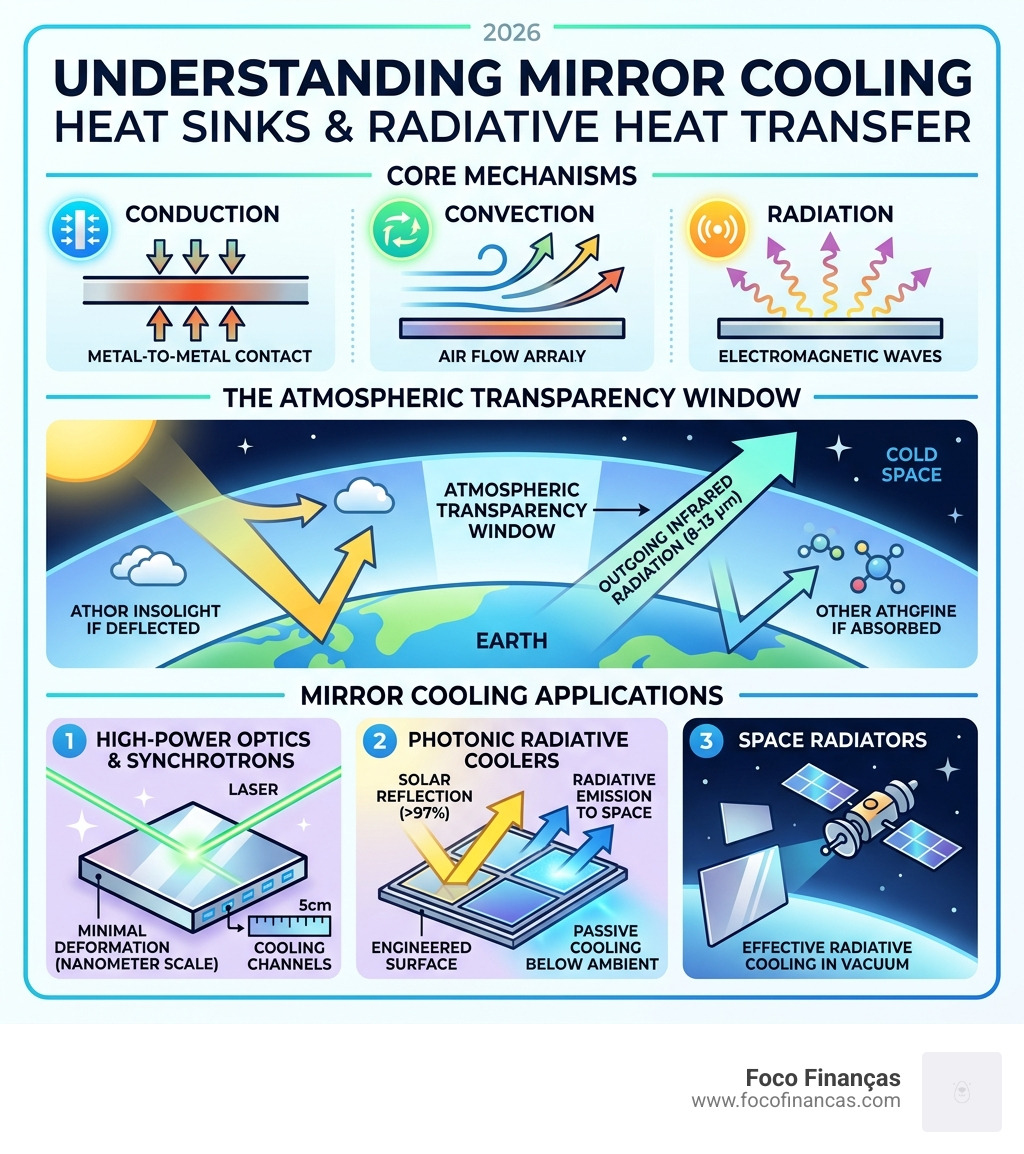
Core Mechanisms of Thermal Management
To master the mirror cooling heat sink, we first have to understand the three pillars of heat transfer: conduction, convection, and radiation. In our everyday atmospheric environment, we rely heavily on the first two. When we press a heatsink onto a CPU, we are using conduction. When a fan blows over those metal fins, we are using convection.
However, in specialized environments like the vacuum of space or high-precision optical labs, the rules change. In a vacuum, convection is non-existent because there is no air to carry the heat away. This leaves radiation as the primary worker. A mirror cooling heat sink designed for space doesn’t look like a computer fan; it looks like a giant, flat, highly reflective panel.
We also have to consider heat transfer coefficients. In high-stakes environments, such as cryogenic mirror systems, we look for coefficients around 1500 W m⁻² K⁻¹ to ensure that the heat moves from the mirror substrate to the coolant effectively. If you want to dive deeper into the basics of these systems, check out A Comprehensive Guide on a Smart Mirror Cooling System.
Optimizing a Mirror Cooling Heat Sink for CPU Performance
For the PC enthusiasts among us, “lapping” a heatsink to a mirror finish is a legendary rite of passage. The goal is to create a perfectly flat surface to maximize metal-to-metal contact.
When we lap a heatsink, we typically use progressive sandpaper grits. While some stop at 2000 grit, research and enthusiast testing suggest that 3000 grit is the “sweet spot.” At this level, the surface is so smooth that it can actually pierce through the microscopic layers of thermal interface material (TIM) to achieve direct contact.
In some famous benchmarks involving older chips like the K6-2, a perfectly polished mirror cooling heat sink allowed the processor to run in the high 30s to low 40s degrees Celsius without any thermal grease at all! This is because a mirror finish minimizes the air gaps that usually require paste to fill. However, we must be careful: if we use too much polish with a thick thermal paste, the “suction” effect might actually make it harder for the paste to spread thinly.
The Physics of the Mirror Cooling Heat Sink
Why does a mirror finish matter so much? It comes down to how photons interact with the surface. Polished copper is an excellent reflector of infrared radiation. In industrial settings, we use mirror-polished copper specifically to bounce heat away from sensitive components.
In high-precision optics, we measure this success using “Surface Shape Accuracy” or RMS (Root Mean Square) height error. If a mirror gets too hot, it warps. Even a tiny warp of a few nanometers can ruin a laser beam’s focus. For example, in high-energy condenser mirrors, thermal absorption can cause a decline in surface accuracy. By using optimized cooling channels, we can reduce this error from 277.66 nm down to 213.79 nm — a 22.96% improvement!
If you’re interested in how mirrors handle other environmental factors like moisture, you might enjoy The Ultimate Guide to a Fog-Free Reflection Every Single Morning.
Impact of Surface Finishes on Radiative Efficiency
Here is where it gets tricky: a mirror finish is great for reflecting heat, but it is often terrible at emitting it. This is a concept called emissivity.
A matte black surface has high emissivity; it’s great at “dumping” heat into the air. A mirror-polished surface has low emissivity; it wants to keep its heat or reflect external heat away. This is why we never recommend polishing the fins of a standard air-cooled heatsink.
Polishing the fins does two bad things:
- It reduces the surface area’s ability to radiate heat into the surrounding air.
- It smooths out the surface so much that air flows over it too “laminarly” (smoothly). We actually want a bit of turbulence to “scrub” the heat off the metal.
Advanced Radiative and Photonic Cooling Strategies
The most exciting frontier in this field is the Stanford-developed photonic radiative cooling mirror. This isn’t just a shiny piece of metal; it’s a high-tech sandwich of silicon dioxide and hafnium oxide on top of a silver layer.
This material is only 1.8 microns thick — thinner than aluminum foil — but it performs a miracle. It reflects 97% of incoming sunlight, so it doesn’t get hot under the sun. At the same time, it emits infrared light at a specific frequency (8 to 13 microns). This frequency is special because our atmosphere is “transparent” to it. The heat passes right through the air and into the 3-Kelvin coldness of deep space.
The result? This mirror cooling heat sink can stay nearly 9 degrees Fahrenheit cooler than the air around it in the middle of a sunny day. Given that 15% of the energy used in US buildings goes toward air conditioning, this technology could be a game-changer for our electricity bills. You can read more about this breakthrough in this article: A cool way to cool: Engineers invent high-tech mirror to beam heat away from buildings into space.
Enhancing Performance with Aperture Mirror Structures
While the Stanford mirror is great, it works best when it has a clear view of the “zenith” (the point directly above it). In crowded cities or tropical areas with lots of water vapor, radiative cooling is harder because the “window” to space is narrower.
To fix this, researchers have developed “aperture mirror structures.” These are secondary mirrors placed around the cooling panel to “funnel” the radiation toward the sky. In tropical climates, these structures can boost cooling power by more than 40%. They also act as a shield, preventing warm winds from blowing over the cooling surface and ruining the effect. For more on this, check out Boosting Radiative Cooling Using Aperture Mirror Tech.
Engineering for High-Load Synchrotron and Space Environments
When we move from rooftops to particle accelerators like the ALS-U or SHINE XFEL, the “heat” isn’t just sunlight; it’s high-energy X-rays that can melt steel. Here, the mirror cooling heat sink must be made of single-crystal silicon.
One innovative design is the “cantilevered” liquid-nitrogen-cooled mirror. By hanging the mirror off a single manifold, we isolate the optical surface from the mechanical stresses of the cooling pipes. We often use a liquid In-Ga (Indium-Gallium) eutectic as a thermal interface. This liquid metal has a staggering thermal conductance of 150,000 W m⁻² K⁻¹, allowing heat to flow out of the silicon and into the copper cooling blades without any vibration.
You can find the technical details of these cryogenic tests here: Experimental testing of a prototype cantilevered liquid-nitrogen-cooled silicon mirror. Additionally, for those interested in the fluid dynamics of these systems, see Optimization, analysis, and thermal performance enhancement of the cooling flow channel for a condenser mirror.
Multi-Segment Cooling and Topology Optimization
To handle the extreme heat of X-ray Free Electron Lasers (XFEL), we use “topology optimization.” This is a fancy way of saying we let a computer design the most efficient, “vein-like” cooling channels possible.
In the SHINE facility, a multi-segment cooling design was able to reduce the RMS height error of a mirror by 12.7 times! Specifically, at 900 eV of photon energy, the error dropped from 13.76 nm to a nearly perfect 1.08 nm. This ensures the laser beam stays sharp even when it’s dumping 43.3 Watts of heat into a tiny 600mm footprint. Learn more about these FEM-based designs here: Multi-segment cooling design of a reflection mirror based on the finite-element method.
Space Radiator Design and Deployment
In space, the mirror cooling heat sink faces a unique challenge: the sun. If a radiator edge catches the sunlight, it can heat up to 120°C instantly.
We generally avoid “finned” heatsinks in space. Why? Because the fins face each other. In a vacuum, a photon emitted by one fin will just hit the fin next to it and get re-absorbed. This is called “photon trapping.”
Instead, we use:
- Flat plate radiators: These maximize the view of deep space.
- Deployable panels: These fold up for launch and unfold in orbit to provide 3-5x more radiating area.
- High-emissivity coatings: These mirrors are designed to be “black” in the infrared spectrum but “white” (reflective) in the visible spectrum.
Frequently Asked Questions about Mirror Cooling
Does a mirror finish on a heatsink improve cooling?
Yes, but only on the base where it touches the CPU. This maximizes conduction by removing air gaps. However, do not polish the fins, as this reduces the convection efficiency and radiation emissivity. For the best results, use 2000 to 3000 grit sandpaper for a true mirror finish.
How does a photonic mirror cool buildings during the day?
It works by being a “selective” mirror. It reflects 97% of the sun’s visible light (so it doesn’t absorb solar heat) while simultaneously being a “window” for infrared heat to escape into space. This allows it to stay 9°F cooler than the air, even in direct sunlight.
What are the limits of silicon mirrors in high-heat applications?
Silicon is chosen for its high thermal conductivity and low expansion at cryogenic temperatures. However, it is brittle. Testing shows that a silicon mirror substrate can withstand a clamping load of at least 2907 N, but any surface cracks longer than 0.275 mm can lead to a catastrophic fracture under high stress.
Conclusion
From the silent, frozen reaches of space to the high-speed processors in our home computers, the mirror cooling heat sink is a vital piece of modern engineering. Whether we are trying to save 15% on our building’s energy bill or trying to keep a multi-billion dollar X-ray laser from warping, the principles of reflection and radiation remain the same.
As we look to the future, the scalability of these technologies is our next big hurdle. We need to move from “pizza-sized” prototypes to large-area coatings that can be sprayed onto every rooftop in a tropical city. If we can master this, we won’t just have cooler gadgets; we’ll have a cooler planet.
For more deep dives into hardware and thermal management, visit our hardware services category.
Future Scalability of Mirror Cooling Heat Sink Technology
The next decade will likely see “off-grid” cooling become a reality for developing nations. By using aperture mirror structures and photonic coatings, we can create refrigeration systems that require zero electricity. In our cities, these “cool mirrors” could mitigate the “Urban Heat Island” effect, making our streets walkable even in the height of summer. The transition from lab-scale “nanophotonics” to industrial-scale “spray-on” coatings is the final frontier in making the world a bit more chill.
