
What Makes a Durable Mirror Touch Panel Worth Your Attention
Durable mirror touch panels are the hardware backbone of any serious smart mirror build.
Here’s a quick summary for anyone who needs a fast answer:
| Feature | What to Look For |
|---|---|
| Touch technology | PCAP (capacitive) for precision; IR overlay for larger sizes |
| Glass type | Tempered or chemically toughened, non-metallic coating |
| Glass thickness | Up to 6mm for capacitive; up to 4mm for acrylic |
| Surface hardness | 6H minimum for scratch resistance |
| Multi-touch points | 10-12 simultaneous touch points |
| Operating temp | -20°C to +60°C for reliable performance |
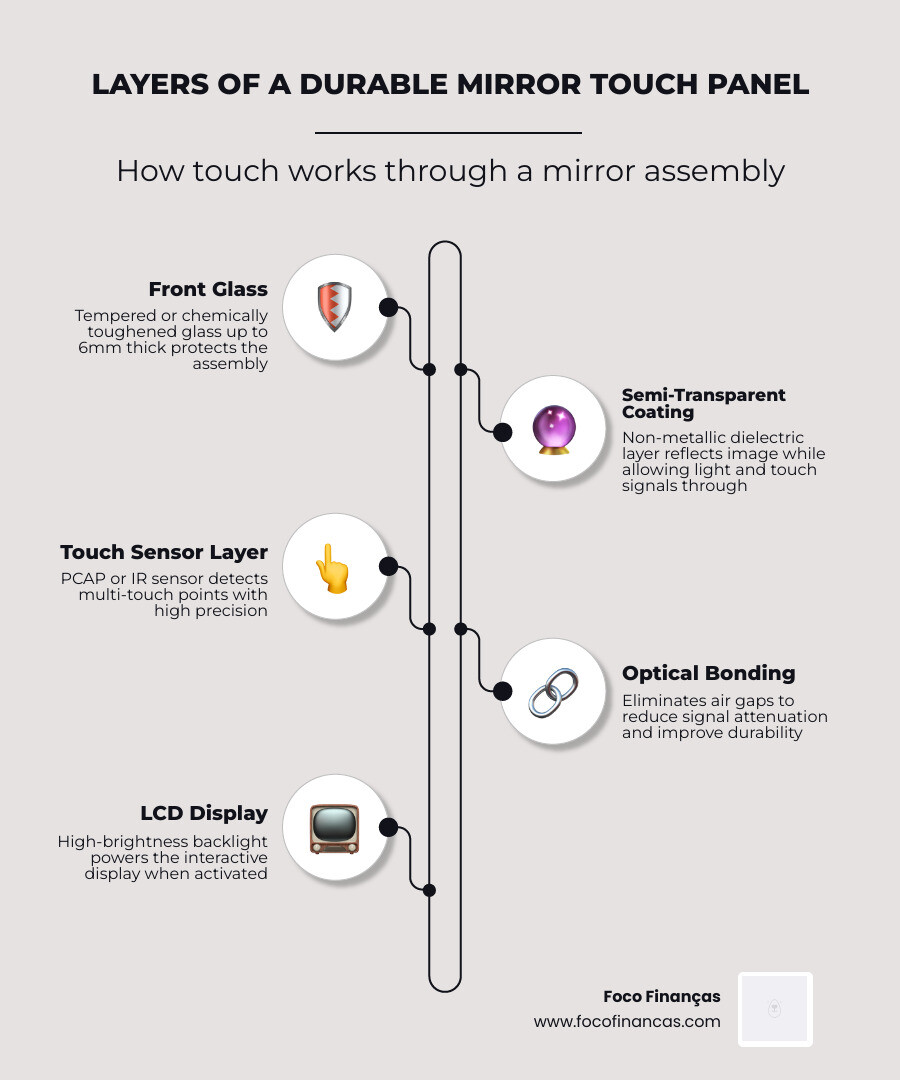
So what exactly is a mirror touch panel? It’s a display assembly that looks like a normal mirror when the screen is off — and transforms into a fully interactive touchscreen when powered on. The magic happens because a semi-transparent mirror coating lets light pass through from behind while still reflecting your image from the front.
The durability part is where most DIY builds fall short.
It’s not just about picking any two-way mirror glass and sticking a touch sensor behind it. The materials, coatings, glass thickness, and bonding method all directly affect how well the touch works — and how long the whole thing lasts. A metallic mirror coating, for example, will completely block capacitive touch signals. An air gap between the glass and the sensor will do the same.
These are the kinds of details that separate a smart mirror that works beautifully for years from one that frustrates you within weeks.
The Core Technology of a Durable Mirror Touch Panel
When we talk about making a mirror “smart,” we are really talking about the invisible layer that translates your finger movements into digital commands. Not all touch technologies are created equal, especially when they have to work through a reflective surface.
In the durable mirror touch panel, three main technologies dominate the landscape: Projected Capacitive (PCAP), Infrared (IR) overlays, and capacitive touch foils. Each has its own strengths depending on whether you are building a small vanity mirror or a massive 85-inch interactive retail display.
Capacitive vs. Infrared in a Durable Mirror Touch Panel
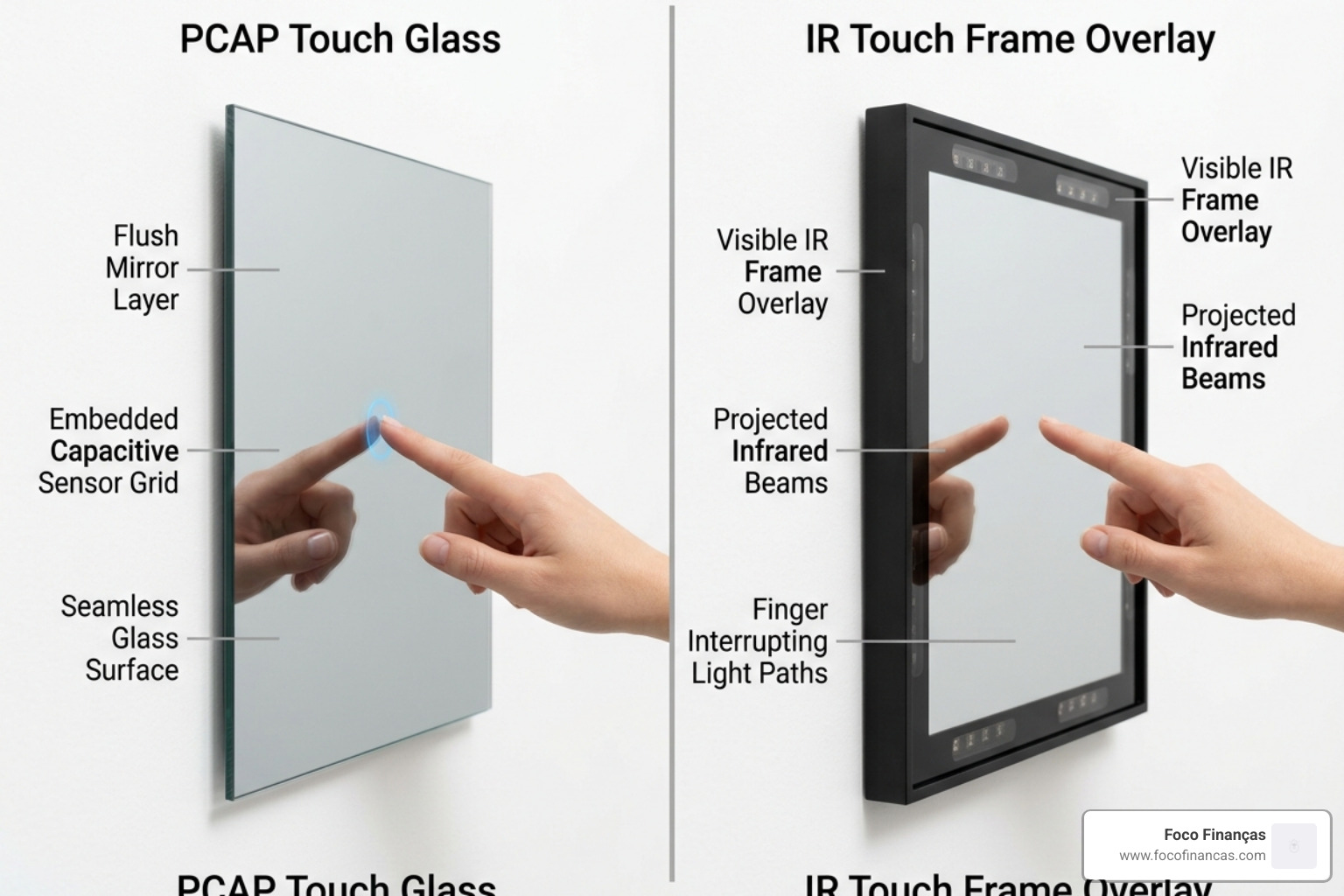
Projected Capacitive (PCAP) is the gold standard for high-end interactive mirrors. It is the same technology used in your smartphone. It uses a conductive grid that detects the electrical properties of your finger. Because the sensor is protected behind a layer of glass, it is incredibly durable. For instance, high-quality PCAP technology can detect up to 12 independent touch points simultaneously through 4mm thick mirror glass.
On the other hand, Infrared (IR) touch overlays work by creating a grid of invisible light beams across the surface of the mirror. When your finger breaks those beams, the system registers a touch. IR is fantastic for very large displays—think 15 to 85 inches—because it is cost-effective at scale. However, since the IR frame sits on top of the glass, it creates a small “lip” or bezel around the edge, which might not be the sleek, flush look everyone wants.
If you are looking for a middle ground, capacitive touch foils are thin, flexible films that you can stick directly to the back of a glass pane. These are popular for DIY projects because they can support solid glass up to 8mm thick. If you want to dive deeper into the setup, you can learn how to add multi-touch interactivity to your smart mirror using these various methods.
Glass Thickness and Sensitivity for a Durable Mirror Touch Panel
One of the biggest hurdles in designing a durable mirror touch panel is physics. The thicker the glass, the harder it is for a capacitive sensor to “see” your finger. Most standard PCAP panels and touch monitors support touch-through-glass functionality up to a limit of 6mm for solid glass. If you push beyond that, the signal attenuates (weakens), and you’ll find yourself tapping the mirror like you’re trying to break it just to get a response.
Acrylic is another option, but it has different physical properties. While it is lighter and harder to shatter, it is much easier to scratch. Most touch foils only support acrylic up to 4mm thick because the material interferes with the electrical field differently than glass does. For a professional finish that lasts, we usually recommend sticking with glass. For a step-by-step on the assembly process, check out our guide on creating a touch screen smart mirror.
Materials That Define Longevity and Performance
A mirror that lives in a bathroom or a high-traffic retail store needs to be tough. We aren’t just looking for “pretty”; we are looking for “industrial-grade.” The choice of base material is the difference between a mirror that stays pristine and one that looks like a scratched-up mess after six months.
The Strength of Tempered and Chemically Toughened Glass
For a truly durable mirror touch panel, we look for tempered glass (often called ESG). This glass is heat-treated to be 3 to 4 times stronger than standard glass. If it does break, it shatters into small, blunt crumbs rather than dangerous shards. Another high-end option is chemically toughened glass, which provides incredible surface hardness-often rated at 6H or higher on the Mohs scale. This means everyday items like keys or rings won’t leave permanent marks on your interactive surface.
Stainless Steel and Robust Framing
While the glass gets all the glory, the frame keeps everything aligned. In commercial settings, a high-quality smart retail mirror uses mirror-finish stainless steel bending for the frame. This provides a sleek look while ensuring the internal electronics are protected from the bumps and grinds of a retail environment.
| Feature | Glass Mirror | Acrylic Mirror |
|---|---|---|
| Scratch Resistance | Very High (6H+) | Low (Scratches easily) |
| Impact Resistance | High (if tempered) | Very High (Shatter-proof) |
| Clarity | Excellent | Good (can yellow over time) |
| Max Touch Thickness | 6mm – 8mm | 4mm |
| Longevity | Decades | 2-5 years |
Why Metallic Coatings Interfere with Touch
This is the “gotcha” moment for many builders. Standard household mirrors use a thick metallic (usually silver or aluminum) backing to create the reflection. Metal is conductive. If you put a capacitive touch sensor behind a metallic mirror, the metal acts as a shield, soaking up all the electrical signals. Your finger won’t be detected at all.
To solve this, a durable mirror touch panel uses non-conductive, dielectric coatings. Products like Schott MIRONA or specialized two-way mirrors use multiple layers of optical coatings to manage reflection and transmission without using a solid sheet of metal. This allows the touch signal to pass through the glass unimpeded. If you want a general technical reference on how capacitive sensing works, it helps explain why conductive mirror backings create such a problem.
High-Performance Specs for Commercial and Retail Use
If you’ve ever tried to look at your phone in direct sunlight, you know the struggle of screen glare. Now imagine that screen is hidden behind a semi-transparent mirror. Visibility becomes a major challenge.
Brightness and Contrast
For a mirror display to be visible in a well-lit room, you need a high-brightness LCD panel. While a standard computer monitor might output 250 nits of brightness, a professional-grade durable mirror touch panel often requires 450 to 800 nits. For example, some 55-inch mirror TV modules feature 800 cd/m² brightness to ensure the “smart” part of the mirror isn’t washed out by room lighting.
24/7 Operation and Reliability
Commercial mirrors in hotels or malls don’t get to take breaks. They need to be rated for 24/7 operation. This requires integrated cooling systems to prevent the LCD from overheating behind the glass. These units are tested to operate in temperatures ranging from -20°C to +60°C, making them resilient enough for almost any indoor environment.
To make these setups even more engaging for customers, many retailers are learning how to make your smart mirror more interactive with a touch frame. This allows for features like virtual fitting rooms or interactive product catalogs.
Installation and Environmental Resistance
How you put the pieces together is just as important as the pieces themselves. If there is even a tiny air gap between your touch sensor and the mirror glass, your touch accuracy will plummet.
Eliminating the Air Gap
In professional manufacturing, we use “bonding” to join the layers.
- Frame Bonding: The touch panel and LCD are joined at the edges. This is cost-effective but can leave a small air gap in the center.
- Optical Bonding: The entire space between the glass and the sensor is filled with a clear adhesive (OCR or OCA). This eliminates reflections, improves contrast, and makes the durable mirror touch panel much more resistant to physical shock and moisture.
Defeating Humidity and UV
Mirrors are often placed in bathrooms or near windows. Humidity can cause standard electronics to corrode, and UV exposure can cause some adhesives or acrylics to turn yellow. A high-quality durable mirror touch panel uses UV-resistant coatings and sealed enclosures to prevent delamination and discoloration over time. If you’re building your own and want to ensure it stands the test of time, see our updated tips on how to make your smart mirror more interactive with a touch frame 2.
Frequently Asked Questions about Mirror Touch Panels
Can I use a touch foil behind a standard household mirror?
No. Standard mirrors have a metallic silver or aluminum backing that is electrically conductive. This backing acts as a Faraday cage, blocking the capacitive signals from the touch foil. You must use a two-way mirror or a dielectric mirror (like Schott MIRONA) that is specifically designed to be non-conductive.
What is the maximum glass thickness for reliable touch performance?
For most PCAP (capacitive) systems, the limit is 6mm of solid glass. Some specialized touch foils can push this to 8mm, but sensitivity may drop at the edges. If you use an IR touch frame, the glass thickness doesn’t matter for the touch sensor, but it will affect the clarity of the display behind it.
How do I clean a durable mirror touch panel without damaging the sensors?
Since the sensors are typically behind the glass, you can clean the front surface just like a normal mirror. However, if the glass has an Anti-Fingerprint (AF) or Anti-Glare (AG) coating, avoid harsh chemicals or abrasive pads. A microfiber cloth and a gentle, ammonia-free glass cleaner are usually best.
Conclusion
At Foco Finanças, we believe that the right hardware is the foundation of any great technological experience. Choosing a durable mirror touch panel isn’t just about finding the cheapest screen; it’s about understanding the synergy between glass chemistry, touch physics, and environmental resilience.
Whether you are looking for a compact interactive mirror monitor for a home project or a large-scale touch sensor glass mirror TV for a luxury hotel, the principles of durability remain the same. Look for tempered glass, high-brightness panels, and non-conductive coatings to ensure your interactive mirror remains a centerpiece for years to come.
Ready to take your project to the next level? Explore more interactive hardware solutions and let’s build something that is truly hard to break.
