
Why Two Way Mirror Glass Is the Most Critical Choice in Your Smart Mirror Build
Two way mirror glass is a semi-transparent panel that reflects light on one side while allowing visibility from the other — and it’s the single most important component in any DIY smart mirror project.
Here’s a quick breakdown of what you need to know before buying:
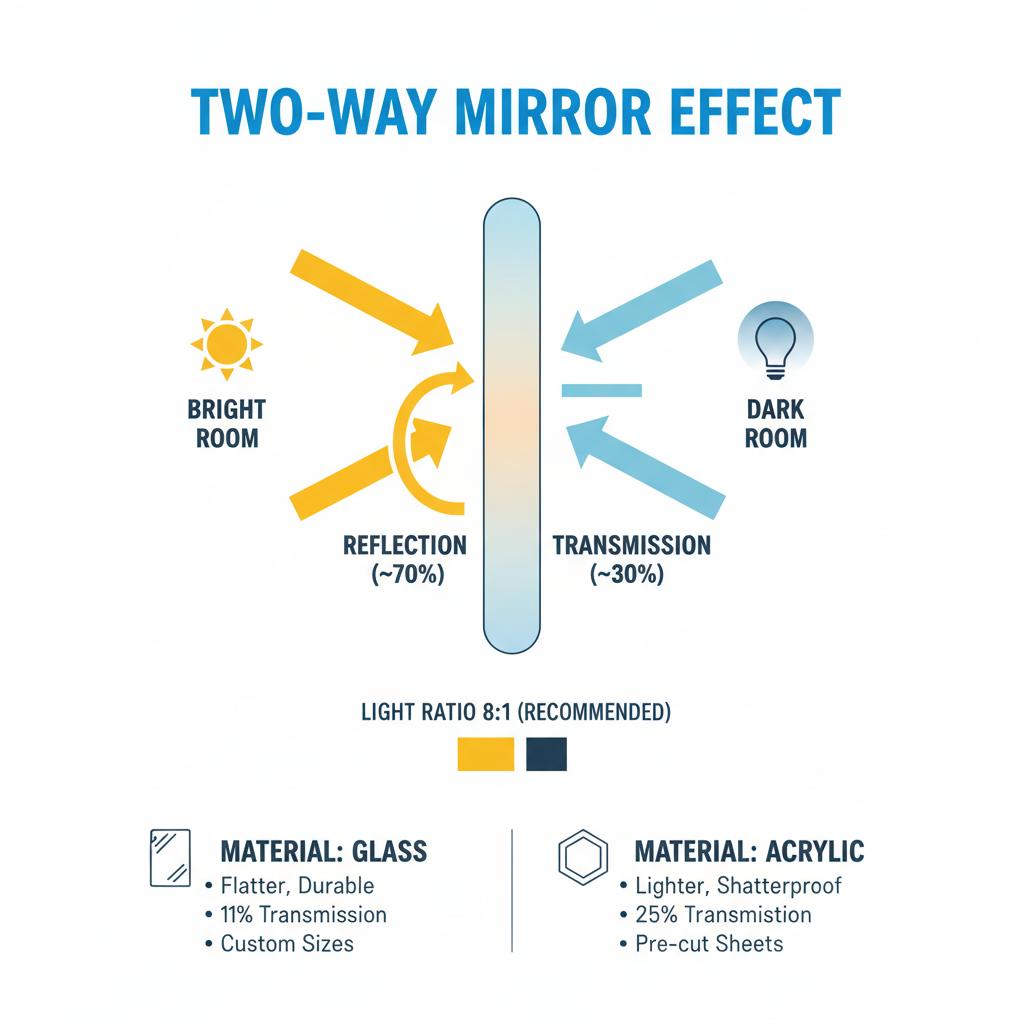
- What it is: A glass (or acrylic) sheet with a thin metallic coating that reflects ~70% of light and transmits ~25-30%
- How it works: The bright side (your face) sees a mirror; the dark side (your display) shines through
- Two main material options: Glass (flatter, more durable) or acrylic (lighter, shatterproof, easier to cut)
- Key spec to check: Light transmission rate — typically 25% for acrylic, ~11% for glass
- Most common sizes: Pre-cut sheets up to 49″ x 97″ (acrylic) or custom up to 96″ x 130″ (glass)
- Recommended light ratio: 8:1 (bright subject side vs. dark display side) for a clean mirror effect
Most smart mirror builds fail not because of bad software or wiring — but because the builder picked the wrong glass.
Too thin and you get a funhouse-style warped reflection. Wrong transmission rate and your display is either invisible or your mirror effect disappears entirely.
This guide walks you through exactly what to look for, what to avoid, and how to source the right panel for your specific build.
Understanding Two Way Mirror Glass: Science and Terminology
To the casual observer, Two way mirror glass looks like magic. In reality, it is a triumph of optical engineering. Unlike a standard household mirror, which has an opaque, thick silver backing that reflects 100% of the light hitting it, a two-way mirror is designed to be “leaky.”
The secret lies in the coating. Most high-quality two-way mirrors utilize a pyrolytic coating or a dielectric beamsplitter. A pyrolytic coating is essentially “baked” onto a grey glass substrate at extremely high temperatures. This makes the finish incredibly durable, scratch-resistant, and even waterproof. Because the coating is semi-transparent, it allows about 25% light transmission (though this can vary between 10% and 30% depending on the specific product).
The “one-way” effect is entirely dependent on the 8:1 light ratio. For the mirror to work, the “subject side” (where you stand to brush your teeth) must be significantly brighter than the “observation side” (where your monitor or tablet sits). If the lights are turned off in your bathroom but your smart mirror display is at full brightness, the “magic” disappears, and you’ll simply see a screen behind a piece of tinted glass.
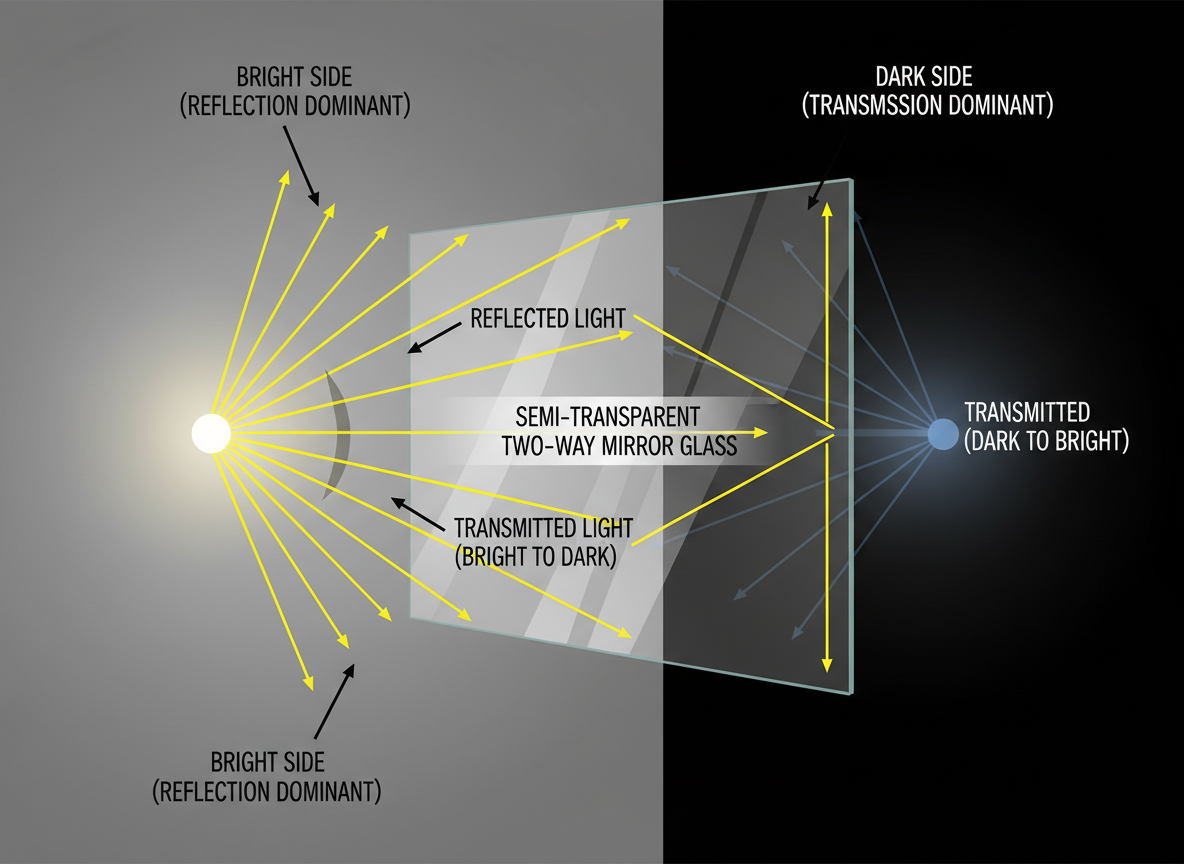
When sourcing your material, you might hear the term dielectric beamsplitter. These are advanced mirrors often used in high-end teleprompters and “hidden TV” installations. They offer a more neutral color shift compared to the slightly grey or blue tint of standard Two way mirror glass, ensuring that your smart mirror interface looks crisp and white rather than muddy.
Glass vs. Acrylic: Choosing the Right Material for Your Project
One of the first crossroads we face in a DIY build is the “Glass vs. Plastic” debate. Both have their merits, but picking the wrong one for your frame size can lead to the dreaded “funhouse effect”—where your reflection looks like it belongs in a carnival.
The Case for Glass
Glass is the gold standard for optical clarity. It is perfectly flat and does not bow or warp under its own weight. If you are building a large bathroom mirror, glass is almost always the better choice.
- Pros: Scratch-resistant, no distortion, easy to clean with standard Windex, handles heat well.
- Cons: Heavy, fragile, and difficult to cut at home without professional tools.
The Case for Acrylic (Plexiglass)
Acrylic is a fantastic alternative for smaller projects or environments where safety is a concern, such as a child’s room. It is significantly lighter—weighing approximately 0.70 lb/sq ft for a standard 1/8″ thickness.
- Pros: Shatterproof, lightweight, and can be cut with a fine-tooth saw or even a laser cutter.
- Cons: Prone to scratching and susceptible to “warping” if it isn’t supported properly in a frame.
| Feature | Glass Two-Way Mirror | Acrylic Two-Way Mirror |
|---|---|---|
| Reflective Quality | Excellent (No distortion) | Good (Prone to warping) |
| Weight | Heavy | Lightweight (0.70 lb/sq ft) |
| Durability | High (Scratch resistant) | Moderate (Scratches easily) |
| Safety | Breaks into shards (unless tempered) | Shatterproof |
| Customization | Requires professional cutting | DIY friendly (Saw/Laser) |
| Thickness Tolerance | Very Tight | +/- 10% (Extruded vs Cast) |
When choosing acrylic, pay attention to whether it is extruded or cast. Extruded acrylic has a more consistent thickness (typically ranging from 0.106″ to 0.130″ for a 1/8″ nominal sheet), which is vital for fitting into tight framing channels. However, if you plan on machining or drilling the material, cast acrylic is less likely to melt or chip.
How to Install and Optimize Your Two Way Mirror Glass
Once you have your Two way mirror glass in hand, the installation phase begins. This is where many DIYers accidentally “break” the illusion by installing the glass backward or failing to light the project correctly. For a deeper dive into the construction phase, check out The Ultimate Guide to Building a Two-Way Smart Mirror.
Identifying the Coated Side of Two Way Mirror Glass
Most two-way mirrors have the reflective coating on just one side. For the best optical results, the coated side should face the bright side (the user).
How do you tell which side is which? Use the fingernail test. Place your fingernail against the surface of the mirror.
- If there is a gap between your finger and the reflection, you are touching the non-coated side (the glass is between you and the reflection).
- If there is no gap and your finger directly touches its reflection, you are touching the coated side.
Pro Tip: When installing, ensure the coated side faces out. This prevents “ghosting,” an optical phenomenon where light reflects off both the front and back surfaces of the glass, creating a blurry double image.
Lighting Requirements for Two Way Mirror Glass
The success of your smart mirror depends on “hiding” the monitor. To do this, your display’s background must be true black. In smart mirrors, black isn’t just a color; it’s the absence of light. Any light bleed from the monitor will be visible through the Two way mirror glass, ruining the effect.
We recommend using a high-contrast monitor and building a “blackout” box behind the glass. This ensures that the only light passing through the mirror comes from your UI elements (like the weather, time, or news feed). Aim for high-brightness (high-nit) displays if your bathroom is particularly sunny.
Essential Buying Factors: Size, Thickness, and Customization
Buying Two way mirror glass isn’t as simple as picking up a frame at a craft store. Because this is a specialized industrial product, you need to be precise with your specifications.
- Thickness: For small mirrors (under 24″), 1/8″ (3mm) thickness is usually sufficient. For larger wall mirrors, we strongly recommend 1/4″ (6mm) to ensure the glass remains rigid and flat.
- Tempering: If you are using glass in a bathroom or a high-traffic area, ask for tempered glass. Tempering increases the strength of the glass by up to 10 times. However, be aware that the tempering process can sometimes introduce a slight “bow” or “funhouse” distortion at the very edges.
- Custom Cuts: Most reputable suppliers offer custom cutting with a tolerance of +/- 1/32″. Always measure your frame’s inner dimensions twice before ordering.
- Edge Finishing: If your mirror will be “frameless,” you must specify polished edges. If the mirror is going inside a frame, sanded edges (which are safe to touch but not pretty) will save you a bit of money.
The cost of your project can vary wildly based on these factors. For a detailed breakdown of what affects the bottom line, read our article on Two-Way Mirror Glass: A Pivotal Determinant of Price.
Maintenance and Longevity Tips for Your Mirror
You’ve spent weeks coding, framing, and mounting your mirror. The last thing you want to do is ruin the sensitive coating with a harsh chemical cleaner.
Two way mirror glass requires a gentle touch. If you are using the acrylic version, never use Windex or any ammonia-based cleaners. Ammonia will eat through the acrylic and cause permanent clouding (crazing). Instead, use a specialized cleaner like Novus 1 or a simple mixture of mild dish soap and water.
For glass versions, standard glass cleaners are usually fine, but always apply the cleaner to a microfiber cloth first, rather than spraying the mirror directly. This prevents liquid from seeping behind the glass and damaging your monitor or electronics.
Key Specs for Longevity:
- Working Temperature: Most acrylic sheets are rated for -30°F to 190°F. Avoid placing your smart mirror directly above a high-heat radiator.
- Handling: Keep the protective film on the glass for as long as possible during the build. Only peel it off once the mirror is safely tucked into its frame.
- Dusting: Use compressed air to blow off dust before wiping. This prevents tiny particles of grit from scratching the surface as you clean.
Frequently Asked Questions about Two-Way Mirrors
Can you see through a two-way mirror in the dark?
If both sides of the mirror are equally dark, you can see through it just like a piece of tinted glass. The “mirror” effect only happens when there is a significant light imbalance. If you turn off all the lights in your house at night, someone standing outside could potentially see into your room if they have a flashlight or if you have a light on inside.
What is the difference between a one-way and two-way mirror?
In common parlance, they are the same thing. The terms “one-way” and “two-way” are used interchangeably to describe a mirror that is reflective on one side and transparent on the other. Technically, “two-way” is the more accurate term because light travels in both directions (transmission and reflection).
How do I prevent distortion in large acrylic mirrors?
Distortion in acrylic is caused by the material flexing. To prevent this, use a thicker sheet (1/4″ instead of 1/8″) and ensure the backing (the monitor and its support structure) is perfectly flat. Avoid using “glue” across the surface of the mirror; instead, secure it at the edges using a rabbeted frame.
Conclusion
Building a smart mirror is one of the most rewarding DIY projects a tech enthusiast can undertake. It blends carpentry, coding, and interior design into a single “wow-factor” piece of hardware. However, the soul of the project is the Two way mirror glass.
By choosing the right material—whether it’s the lightweight versatility of acrylic or the uncompromising clarity of glass—and respecting the physics of light transmission, you ensure that your project looks professional rather than like a high-school science experiment.
At Foco Finanças, we believe that the best projects start with the best information. Take your time, measure twice, and choose your optics wisely. Ready to dive deeper into custom builds? Start your hardware project today and turn your reflection into a source of information.
